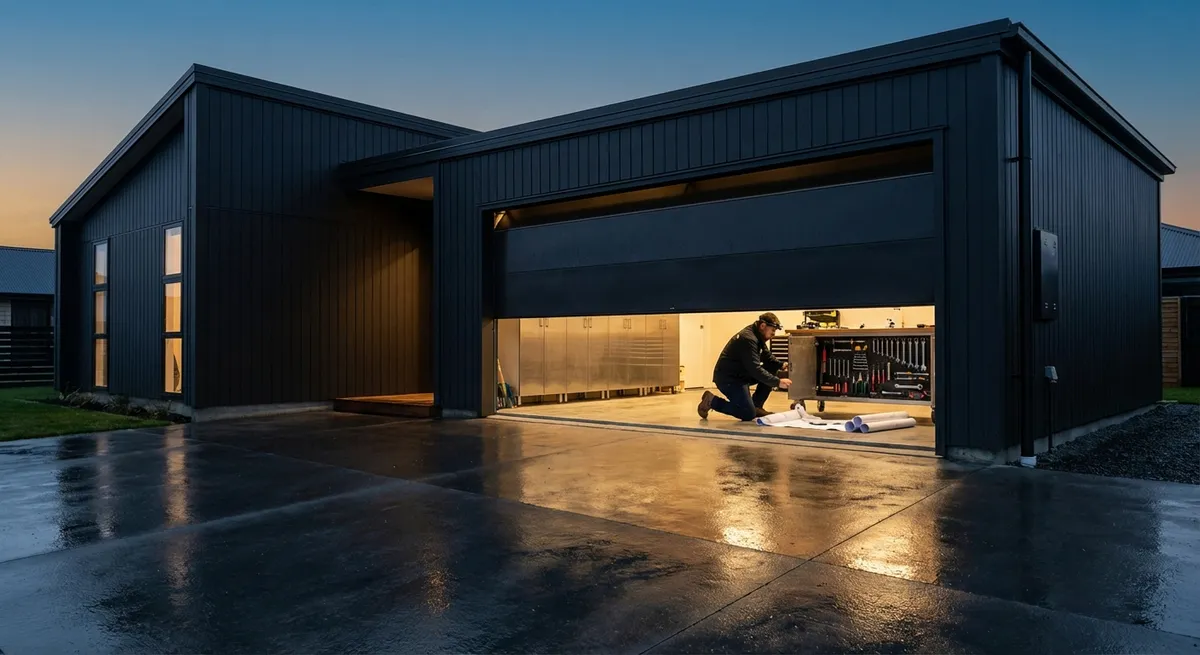
Garages are often the most technically complex access point in a refined home—and paradoxically, the most neglected. When something fails, it rarely does so discreetly: jarring noises, misaligned doors, or unpredictable openers quickly disrupt the quiet choreography of a well‑run household. This guide looks beyond basic troubleshooting and explores repair solutions calibrated for homeowners who expect reliability, subtlety, and longevity, not just a temporary fix.
Below are five exclusive, detail‑driven insights that elevate garage repair from “good enough” to genuinely exceptional.
1. Treat the Garage Door as Precision Hardware, Not Just a Barrier
Most repair attempts start with what is visibly wrong—a crooked panel, a loud opener, a door that won’t close. Sophisticated repair, however, begins with the assumption that the entire system functions like precision hardware: tracks, springs, bearings, opener, and door skin all interact.
A premium repair approach starts with a structured inspection: track plumb and level, spring balance, hinge integrity, cable wear, and opener force settings. Instead of simply “tightening everything,” a discerning technician evaluates tolerances. For example, a door that binds only in the last 6 inches of travel may indicate a track that is microscopically racked, not “bent” in any obvious way. Similarly, surface rust on torsion springs isn’t merely cosmetic—it can be an early indicator of compromised flexibility that will change how the door balances.
In practice, that means insisting on a repair quote that references specific components and measurements: spring cycle rating, track gauge, roller type (nylon vs. steel, sealed vs. open bearing), and opener force calibration. You are not paying to “fix my garage door”; you’re investing in re‑establishing a calibrated system that operates with quiet, repeatable precision.
2. Specify Components by Performance, Not Just Price
Homeowners are often offered “good, better, best” packages without any real explanation of what separates them. An elevated repair strategy flips this dynamic: you decide based on performance criteria, and price becomes a consequence, not the lead variable.
Torsion springs, for example, are commonly rated for 10,000 cycles—adequate for entry‑level houses, less so for homes where the garage is the primary entrance. Specifying 25,000–50,000 cycle springs dramatically extends service intervals and ensures more predictable operation. The same reasoning applies to rollers: sealed, high‑quality nylon rollers not only reduce noise but also reduce vibration transmitted to tracks, hardware, and the door itself, prolonging component life.
The opener deserves similar scrutiny. Instead of simply “upgrading the motor,” focus on drive type (belt vs. chain vs. direct drive), soft‑start/soft‑stop capability, and integrated diagnostics. A belt‑drive unit with DC motor and motion‑profiling will handle a balanced door more gently, reducing mechanical shock. The result is not just a quieter system, but one that moves with a smooth, almost architectural elegance consistent with the rest of the home.
3. Reframe “Noise” Complaints as Clues to Mechanical Health
Unwanted noise is often treated as an annoyance when it should be treated as data. Distinct sounds point to specific issues, and refined repair work uses this acoustic feedback as a diagnostic tool rather than simply masking it with lubricant.
A harsh metallic clank during opening can indicate slack in the opener chain or a loose trolley assembly; a rapid staccato rattle may suggest misaligned hinges or worn roller stems vibrating in the brackets. A deep, resonant rumble can signal that the door is out of balance and forcing the opener to work harder than designed, even if it still “works.” Lubricant applied indiscriminately might quiet things temporarily while allowing an underlying misalignment to worsen.
The sophisticated response is selective correction: tightening only what should be rigid, isolating what should float, and lubricating only where friction is intended to be reduced. Garage hardware, like any refined mechanism, has intentional play and intentional constraints; erasing that distinction with over‑tightening or over‑lubricating often creates future failures. A conscientious professional will explain which sounds are “normal mechanical signature” and which are early warning signs you should never ignore.
4. Protect the Garage as a Climate Buffer, Not Just a Storage Zone
For many homes, the garage is a thermal and moisture buffer between the outdoors and the primary living space. Poorly executed repairs can erode this protective role, leading to subtle but costly side effects: higher energy bills, premature rusting of tools and vehicles, and even damage to finishes in adjacent interior rooms.
Weatherstripping and bottom seals are often treated as cosmetic or optional. In a performance‑oriented repair plan, they are critical. A miscut bottom seal or a poorly tensioned side seal can allow capillary water intrusion during heavy rain, which then accelerates corrosion in lower panel hardware and spring anchor points. Likewise, an uninsulated replacement panel installed into an otherwise insulated door creates a thermal weak spot, similar to a single‑pane window in an otherwise double‑glazed façade.
When approving repair work, ask explicitly about R‑value of replacement panels, compatibility of seals with your climate (EPDM vs. vinyl in cold or hot conditions), and how the repair will affect air infiltration. In homes with conditioned or semi‑conditioned garages, this isn’t a luxury detail; it’s part of protecting HVAC performance and adjoining living spaces from temperature swings and moisture migration.
5. Make Safety Systems Non‑Negotiable—and Precisely Calibrated
Garage door safety is often reduced to a checkbox—“Yes, there are sensors”—but premium repair standards demand more than simple presence. The interplay between mechanical balance, opener force settings, and safety sensors determines whether your system merely passes a basic test or actually protects people, vehicles, and property as intended.
A properly repaired door should be capable of manual operation with minimal effort; if you cannot lift it smoothly by hand with the opener disconnected, the springs are not correctly balanced. An opener that is compensating for a heavy or binding door may still function, but it will be operating near its force limits—compromising both its lifespan and safety margin. Modern units allow fine‑tuning of travel and force in both directions; these settings should be checked, not assumed.
Photo‑eye sensors must be correctly aligned, but also correctly placed: mounted at the appropriate height, protected from accidental bumps, and wired without sloppy, exposed runs. After any significant repair, the safety reversal should be tested with something more realistic than an empty cardboard box: many professionals use calibrated test blocks to ensure compliance with recognized safety standards. As a homeowner, insist on a demonstrated safety test at the conclusion of any substantial repair, not just a verbal assurance.
Conclusion
Garages in sophisticated homes deserve the same level of intentionality as kitchens, façades, and mechanical rooms. Repair work should not be a rushed reaction to failure, but a considered recalibration of a complex system that controls access, safety, energy performance, and daily convenience. By treating the door as precision hardware, specifying components by performance, interpreting noise as diagnostic data, safeguarding the garage as a climate buffer, and demanding rigor in safety calibration, you elevate every repair from a mere fix to a long‑term, value‑protecting solution.
In homes where details matter, the garage should never be the weak link—only the most discreetly reliable one.
Sources
- Consumer Product Safety Commission – Garage Door Safety - Authoritative guidance on safety features, entrapment protection, and best practices for garage door systems
- U.S. Department of Energy – Insulation and Air Sealing - Explains how insulation and air sealing in buffer zones like garages affect whole‑home efficiency
- International Door Association (IDA) – Homeowner Garage Door Safety Tips - Industry organization offering detailed safety and maintenance recommendations for residential garage doors
- LiftMaster – Garage Door Opener Safety and Security Features - Major manufacturer’s overview of modern opener technology, force settings, and safety innovations
- UL Standards – Door, Drapery, Gate, Louver, and Window Operators and Systems (UL 325 Overview) - Technical background on the safety standard governing automatic door and gate operators
Key Takeaway
The most important thing to remember from this article is that this information can change how you think about Repair Solutions.