The most satisfying garage upgrades are rarely the loudest or the most obvious. They are the quiet refinements—the details that change how the space works, feels, and endures over time. For homeowners who expect their garage to perform with the same composure as the rest of the residence, the right upgrades are less about spectacle and more about precision: measured improvements that solve real problems while elevating the everyday experience.
This guide explores a more considered approach to garage upgrades—solutions that address function, comfort, and longevity while preserving a sense of refined minimalism. Along the way, you’ll find five exclusive insights that discerning homeowners tend to notice first, and miss the least once they’ve been resolved.
Reframing the Garage: From Utility Zone to Technical Room
Treating the garage as a “technical room” rather than a catch-all storage area changes the upgrade conversation entirely. In this mindset, every element—lighting, flooring, climate, access, and storage—earns its place by solving a specific problem with precision.
A garage that is too hot in summer, too cold in winter, dimly lit, and poorly sealed does more than create discomfort; it accelerates wear on vehicles, tools, finishes, and stored belongings. Upgrades that address these fundamentals often deliver the highest return in livability, even if they are almost invisible at first glance.
Instead of starting with aesthetic enhancements, begin with performance: air, light, temperature, sound, and motion. Once those are handled with care, the garage stops feeling like an afterthought and begins to function as a well-appointed support space—a quiet, technical extension of the home.
Precision Lighting: Layered Illumination for Work and Display
Most garages are underlit by a single central fixture, creating shadows, eye strain, and frustration during any detailed task. A refined upgrade strategy treats garage lighting as layered, not singular.
Task lighting over workbenches, tool walls, and entry thresholds reduces fatigue and improves accuracy for repairs, detailing, and inspections. High‑CRI (Color Rendering Index) LED fixtures (CRI 90+) allow you to see paint imperfections, fluid leaks, and surface flaws with greater clarity—an unspoken advantage for anyone who maintains premium vehicles or equipment.
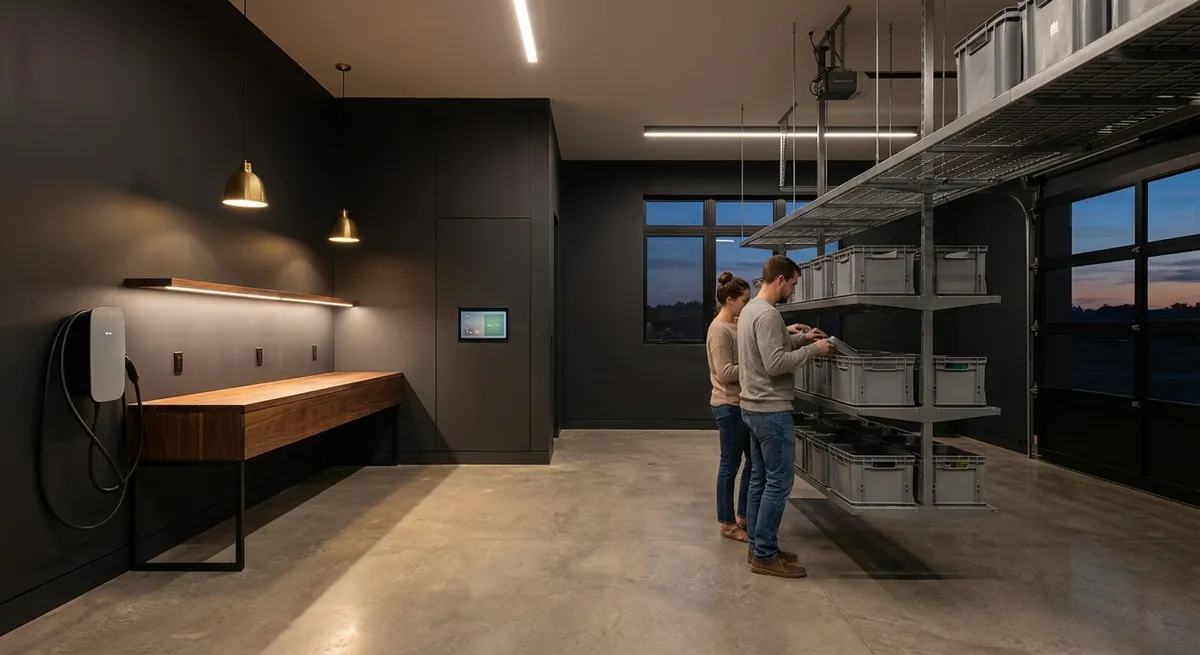
Ambient lighting, such as continuous LED strips or evenly spaced linear fixtures, should be planned to reduce dark corners and shadows around parked cars. Wall‑mounted sconces or low‑glare fixtures near doors and transitions help with safe movement without the harshness of a single overhead bulb.
Exclusive Insight #1: “Light the Edges, Not Just the Center”
Homeowners often focus on a central, brighter fixture and still feel the garage is poorly lit. In practice, your perception improves more when the perimeter is well illuminated—around tires, storage, and entry points. Lighting the boundaries of the garage reduces visual strain dramatically and makes the entire room feel more composed and intentional.
Intelligent Climate Control: Thermal Details That Protect More Than Comfort
Climate in the garage is often treated as an afterthought, yet it has a measurable impact on the life of vehicles, finishes, and storage items. Excess humidity invites corrosion and mold; excessive heat and cold stress paints, seals, rubber components, and power tools.
Thermally upgrading the garage does not necessarily mean installing a full HVAC system. Instead, a layered approach works best:
- Air sealing around door jambs, thresholds, and wall penetrations
- Insulated garage doors rated for your climate zone
- Modest wall and ceiling insulation where feasible
- A well‑placed, efficient mini‑split or dehumidifier for high‑value spaces
This approach stabilizes temperatures, limits condensation on concrete slabs, and slows rust on stored metal tools or equipment. It also makes the garage far more pleasant for any repair work that takes more than a few minutes.
Exclusive Insight #2: “Target Humidity Before You Chase Temperature”
Many homeowners instinctively try to heat or cool a garage that’s still humid or poorly sealed. Regulating humidity first—often with a correctly sized dehumidifier and basic air sealing—can preserve tools, prevent musty odors, and protect vehicles more effectively than simply adding a heater or AC. Once humidity is managed, any additional climate control you invest in works more efficiently and feels noticeably more comfortable.
Flooring as Infrastructure: Beyond Cosmetic Coatings
Garage flooring is frequently reduced to a cosmetic upgrade, but for a discerning owner, it is part of the performance infrastructure of the space. The right surface must tolerate hot tires, chemicals, dropped tools, and repeated cleaning, while supporting both heavy static loads (vehicles, storage) and dynamic activity (repairs, projects).
Professional‑grade epoxy, polyaspartic, or polyurethane systems with proper surface preparation resist peeling, staining, and tire pickup—problems that plague cheaper DIY kits. Alternatively, high-quality modular tile systems with integrated channels can manage small spills and provide underfoot comfort while still allowing access for repair or reconfiguration.
The subtle luxury is not the gloss; it is the ease of maintenance. A well‑chosen floor allows oil drips, brake dust, and general grime to be wiped away instead of absorbed. This preserves both aesthetics and safety, reducing slip hazards and ensuring the floor doesn’t become a permanent record of every mishap.
Exclusive Insight #3: “Consider How You’ll Clean Before You Choose the Surface”
Many flooring decisions are made based on color charts, not cleaning routines. Yet the ease, frequency, and method of cleaning will define your satisfaction years later. If you prefer quick, low‑effort maintenance, surfaces that tolerate squeegeeing and pressure washing without degradation may be more valuable than a showroom shine. Planning for the cleaning process at the outset is often the difference between a floor that ages gracefully and one that becomes a frustration.
Storage That Protects, Not Just Organizes
Most garage storage solutions are built around the idea of capacity—how many bins, shelves, or hooks can be fitted into a given wall. A more refined approach focuses less on volume and more on protection: humidity, dust, pests, and accidental impact.
Closed cabinetry shields power tools and fine equipment from airborne dust and metal particles created during grinding, cutting, or sanding. Elevated storage keeps boxes away from slab moisture and minor flooding. Lockable compartments protect specialty tools, lubricants, and hazardous materials from small hands or unintended access.
Pegboards and open racks still have their place, but they should be used for items that are rugged and frequently accessed, not delicate or highly finished. When thoughtfully balanced, the garage becomes less visually cluttered, easier to clean, and significantly kinder to whatever you store there.
Exclusive Insight #4: “Design for the First Minute of a Project, Not the Last”
Common organizational systems emphasize where things are put away, not how easily they are retrieved. Yet it’s the first minute of any task—finding the correct tool, accessing the right parts—that defines whether you will even start smaller repair or maintenance jobs. Arranging storage so that your most frequently used tools are accessible without moving other items dramatically increases how often the garage is actually used as a functional workspace instead of a passive storage zone.
Entry, Safety, and Quiet Operation: The Subtle Mechanics of Daily Use
While the garage door itself is a major component, the entire entry sequence deserves careful attention: exterior lighting, threshold design, hardware quality, sensor placement, and backup access in the event of a power failure.
Quiet, well-calibrated openers with soft-start and soft-stop functions preserve both mechanical components and household serenity. High-quality weatherstripping at the bottom seal and side jambs keeps water, debris, and pests at bay. Motion-activated, low-glare lighting reduces fumbling when your hands are full, and properly positioned photoelectric sensors help prevent accidental damage.
Backup battery systems and manual release mechanisms ensure that you are never locked out—or trapped in—during outages. For homeowners with high-value vehicles or equipment, integrated smart access systems provide tailored control over who enters and when, without the clumsy feel of old, shared remotes.
Exclusive Insight #5: “Calibrate for Silence as a Diagnostic Tool”
Noise from the door, opener, or hardware is not just an annoyance; it is often an early diagnostic signal. A garage system that has been tuned for quiet operation makes small changes in sound far easier to detect—subtle shifts that can warn you of emerging issues before they become failures. Treating silence as a maintenance benchmark rather than a luxury helps you identify misalignment, worn rollers, or tension problems long before they escalate into costly repairs.
Conclusion
Refined garage upgrades are less about dramatic transformation and more about composed performance. When lighting, climate, flooring, storage, and entry systems are chosen with intent, the garage evolves into a disciplined technical space—one that safeguards your vehicles and tools, supports precise repair work, and remains visually calm.
For the discerning homeowner, the real luxury is reliability: a garage that functions cleanly, quietly, and consistently, without demanding constant attention. By focusing on targeted, high-impact upgrades—and by embracing the five insights above—you align the garage with the rest of your home’s standards: understated, capable, and prepared for whatever the day requires.
Sources
- U.S. Department of Energy – Insulation and Air Sealing – Guidance on insulation and air sealing principles applicable to attached garages
- Energy Star – Dehumidifiers and Indoor Humidity – Information on selecting and sizing dehumidifiers to control moisture in enclosed spaces
- U.S. Consumer Product Safety Commission – Garage Door Safety – Official recommendations for safe operation and maintenance of garage doors and openers
- Occupational Safety and Health Administration (OSHA) – Lighting Requirements – Baseline standards on workplace lighting that inform effective task lighting in workspaces like garages
- Sherwin-Williams – Industrial & Commercial Floor Coatings – Technical overviews of resinous flooring systems commonly used in high-performance garage environments
Key Takeaway
The most important thing to remember from this article is that this information can change how you think about Upgrades.