A well‑kept garage does more than store vehicles and tools; it quietly underwrites the comfort, safety, and value of your home. True maintenance is not a scramble to fix what breaks, but a disciplined, almost invisible practice that prevents failures from appearing in the first place. When you approach your garage with the same scrutiny you’d reserve for a fine automobile or a bespoke kitchen, routine care becomes a refined, strategic exercise—one that rewards you with silence, reliability, and an unmistakable sense of order.
Reframing the Garage: From Afterthought to Mechanical Suite
Most garages are treated as architectural footnotes—useful, but rarely curated. Yet this is the space that shelters one of your most valuable assets, interfaces with your home’s envelope, and often houses electrical panels, water heaters, and HVAC equipment. Thinking of the garage as a “mechanical suite” rather than a catch‑all storage room transforms how you maintain it.
Begin with a simple audit. Stand at the threshold and take in the entire volume: door tracks, ceiling, junction boxes, floor drains (if present), wall penetrations, and storage systems. You’re not merely looking for obvious damage, but for misalignment, sagging, staining, condensation, and sound. A premium maintenance mindset is observational: you listen for the opener straining, note where dust accumulates unusually fast, and observe how quickly the space cools or heats compared with the rest of the home.
This perspective shift is subtle but powerful. Instead of reacting to failures, you start managing a system. And like any refined system—whether a performance engine or a climate‑controlled wine cellar—the garage rewards consistent, thoughtful care more than occasional heroic repairs.
Insight 1: Calibrating the Door as a Safety System, Not Just a Moving Panel
A garage door is the largest moving component in most homes, and it’s often underestimated. Treating it as a safety system rather than a simple entry point changes how you maintain it.
Once a quarter, perform a “functional inspection” rather than a casual glance:
- Balance test: With the opener disengaged, manually lift the door halfway and release. A properly balanced door should hover or move slowly. If it slams shut or rockets upward, tension is off and stresses both hardware and opener.
- Photo eye alignment: Confirm the sensors are mounted at the correct height (typically 4–6 inches above the floor) and that the indicator lights are steady, not flickering. Misalignment may not stop the door from closing every time—but it degrades safety.
- Force reversal test: Using a piece of scrap wood laid flat under the closing door, ensure the door reverses immediately upon contact. This is a non‑negotiable safety check, especially in homes with children or pets.
Refined maintenance here is about margin—ensuring everything operates with headroom rather than at the edge of acceptable performance. If any test fails, stop using the door as normal and engage a qualified technician. A premium garage does not tolerate “almost fine” in its heaviest moving mechanism.
Insight 2: Managing Moisture as the Silent Saboteur
Moisture is rarely dramatic in a garage; it’s insidious. It seeps through slab hairline cracks, condenses on cold tools, and slowly corrodes door hardware and stored belongings. The most sophisticated maintenance routines treat moisture control as a central theme, not an afterthought.
Start at the perimeter and work inward:
- Weatherstripping and thresholds: Examine bottom seals and side/top weatherstripping for brittleness, gaps, or flattening. Even modest air leaks admit humid air, road spray, and pests. Replace compromised seals promptly; it’s a small investment with outsized benefits.
- Floor inspection: Look for efflorescence (white, chalky deposits) or dark staining patterns—both are clues to water migration. Hairline cracks can be stable, but widening or moisture‑active cracks should be documented, then reviewed by a concrete or structural professional.
- Ventilation strategy: A closed garage can trap vehicle exhaust moisture, especially in winter climates or coastal regions. Consider a quiet, timer‑controlled exhaust fan or, where climate permits, passive venting options. Even a carefully timed practice of briefly opening the door to purge moist air after parking can help.
Elevating moisture control from “wipe up puddles” to “manage the environment” dramatically extends the life of metal fixtures, stored items, and the building envelope. In premium homes, this is the difference between a garage that merely functions and one that ages gracefully.
Insight 3: Creating a Service Corridor for Critical Utilities
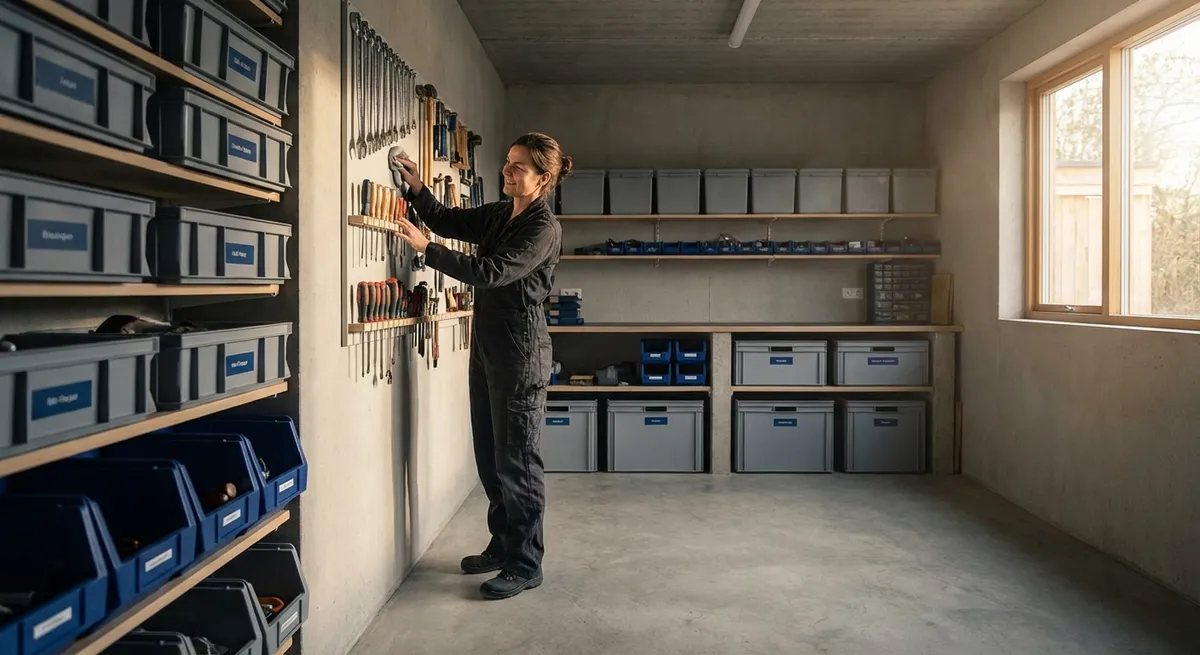
Many garages hide critical infrastructure—electrical panels, shut‑off valves, water heaters, EV chargers—behind a curtain of boxes, sports gear, and seasonal décor. This clutter doesn’t just look unruly; it actively undermines safety and maintenance.
Adopt the concept of a service corridor:
- Clearance discipline: Maintain clear, code‑respecting access around electrical panels and mechanical equipment. Beyond legal requirements, this ensures that in an emergency—tripped breakers, water leaks—you can act immediately.
- Visual access: Avoid shelving that blocks sightlines to key components. A clean view lets you spot rust on a water heater base, discoloration around a junction box, or condensation on refrigerant lines before a failure escalates.
- Labeled order: Use discreet, high‑quality labels for shut‑off valves, subpanels, and dedicated circuits (e.g., EV chargers or door openers). This transforms panicked troubleshooting into a composed, almost effortless sequence.
This is maintenance as choreography: when a breaker trips during a storm or a minor leak appears, you move through the space with clarity instead of scrambling. A well‑designed service corridor is invisible most days—but when you need it, it’s invaluable.
Insight 4: Sound and Vibration as Early Warning Instruments
Sophisticated homeowners pay attention not only to what they see, but what they hear and feel. In a garage, sound and vibration are early signals of mechanical issues that haven’t yet become visible.
Cultivate a mental “sound profile” of your garage:
- Opener acoustics: Become familiar with the normal hum, whir, and clack sequence when the door operates. New rattles, grinding tones, or delayed engagement often indicate loose hardware, worn rollers, or chain/belt tension issues.
- Vibration transfer: If you feel excessive vibration through the adjacent interior wall or ceiling when the opener runs, it may be over‑fastened or improperly isolated. Small adjustments—such as using vibration‑dampening mounting brackets—can significantly reduce mechanical stress and noise.
- Intermittent noises: Random pops or ticks in temperature swings can signal expansion and contraction in framing, but repetitive or localized sounds near a particular bracket, joint, or hinge deserve closer inspection.
Treating sound and vibration as diagnostic tools allows you to intervene when issues are inexpensive and contained, rather than waiting for a snapped spring, derailed door, or failed opener. It’s a distinctly refined approach—less “wait for something to break,” more “tune a mechanical instrument.”
Insight 5: Establishing a Seasonal “Garage Preservation Ritual”
The most effective maintenance isn’t complicated; it’s ritualized. Instead of an overwhelming annual overhaul, consider a concise seasonal ritual that treats the garage with the same respect as a luxury vehicle’s service schedule.
A simple, high‑impact framework:
- Spring: Focus on recovery and reset. Clean road salts or de‑icing chemicals from the floor, inspect for corrosion on door hardware and vehicle storage racks, verify GFCI outlets and test any carbon monoxide or heat detectors. Evaluate pest defenses as warmer weather approaches.
- Summer: Prioritize heat and air management. Check insulation at the garage‑to‑house wall, examine fire‑rated doors for proper closure, and confirm that any ventilation or exhaust strategies are functioning. Inspect seals and lubricate moving parts on the door and opener (using manufacturer‑approved lubricants only).
- Autumn: Prepare for load and weather. Inspect weatherstripping before storms and temperature drops; test openers’ battery backup (if installed); ensure that floor drains or slopes manage meltwater efficiently. Rotate and reorganize storage so winter‑critical items are immediately accessible.
- Winter: Maintain safety and responsiveness. Keep photo eyes clean from dust and salt film, avoid stacking snow or ice near door tracks and exterior seals, and monitor the garage temperature if water lines or sensitive equipment are present.
By assigning each season a precise role, maintenance no longer feels like a burden but a brief, deliberate preservation ritual. Over time, this rhythm is what separates a constantly problematic garage from one that simply works, year after year, with a quiet, dependable elegance.
Conclusion
A garage in disarray doesn’t fail all at once; it erodes gradually—through misaligned doors, creeping moisture, inaccessible utilities, and unchecked mechanical wear. Elevating your approach from reactive fixes to a refined maintenance philosophy rewrites that story. When you treat the garage as an integrated mechanical suite, calibrate the door as a safety system, manage moisture strategically, preserve access to critical utilities, listen for subtle mechanical cues, and establish a seasonal ritual, you transform a utilitarian space into a quietly sophisticated asset.
The reward is not merely aesthetic. It’s the absence of emergencies, the confidence that your vehicle and infrastructure are properly sheltered, and the satisfaction of a space that matches the standard of the rest of your home—discreetly, consistently, and with the kind of reliability that feels almost luxurious.
Sources
- U.S. Consumer Product Safety Commission – Garage Door Safety - Official guidance on garage door safety features, testing, and injury prevention
- International Code Council – Residential Code Essentials - Provides context on clearances, fire separation, and safety requirements relevant to garages
- U.S. Department of Energy – Air Sealing Your Home - Explains the importance of sealing gaps and cracks, applicable to garage weatherstripping and envelope control
- University of Minnesota Extension – Concrete Floors and Moisture - Discusses moisture behavior in garage slabs, efflorescence, and mitigation strategies
- National Fire Protection Association – Home Electrical Safety - Offers best practices for safe access to electrical panels and equipment often located in garages
Key Takeaway
The most important thing to remember from this article is that this information can change how you think about Maintenance.