A well‑kept garage is less about visible perfection and more about invisible reliability. The doors glide without complaint, the opener answers with a whisper, and every surface feels intentionally under control instead of “good enough for storage.” True refinement in garage maintenance is not showy; it is simply the satisfying absence of surprises—especially the costly, inconvenient kind.
For homeowners who expect their property to perform as well as it presents, the garage is no place for guesswork. The following maintenance insights move beyond basic checklists and into the realm of precision care—subtle, technical refinements that preserve both function and long‑term value.
1. Treat the Garage Door as a Moving Facade, Not a Utility Panel
A garage door is often the largest moving architectural element on your property, yet it is frequently maintained as if it were just another appliance. This mindset leads to reactive, crisis‑driven repairs instead of discreet, preventative care. Start by assessing the door as you would an exterior façade: examine the finish for micro‑cracks, UV fading, and early moisture intrusion at seams and trim. Addressing minor coating failures now prevents warping, swelling, and corrosion that compromise both performance and curb appeal. Internally, treat the door’s movement like a precision mechanism. Listen for tonal changes—new rattles, hollow thuds, or higher‑pitch squeaks often signal mounting bolts loosening, interior panel delamination, or rollers beginning to deform. This “architect + engineer” mindset ensures the door remains both aesthetically composed and mechanically exact, rather than an afterthought that suddenly demands an emergency replacement.
2. Calibrate, Don’t Just Lubricate, the Moving Hardware
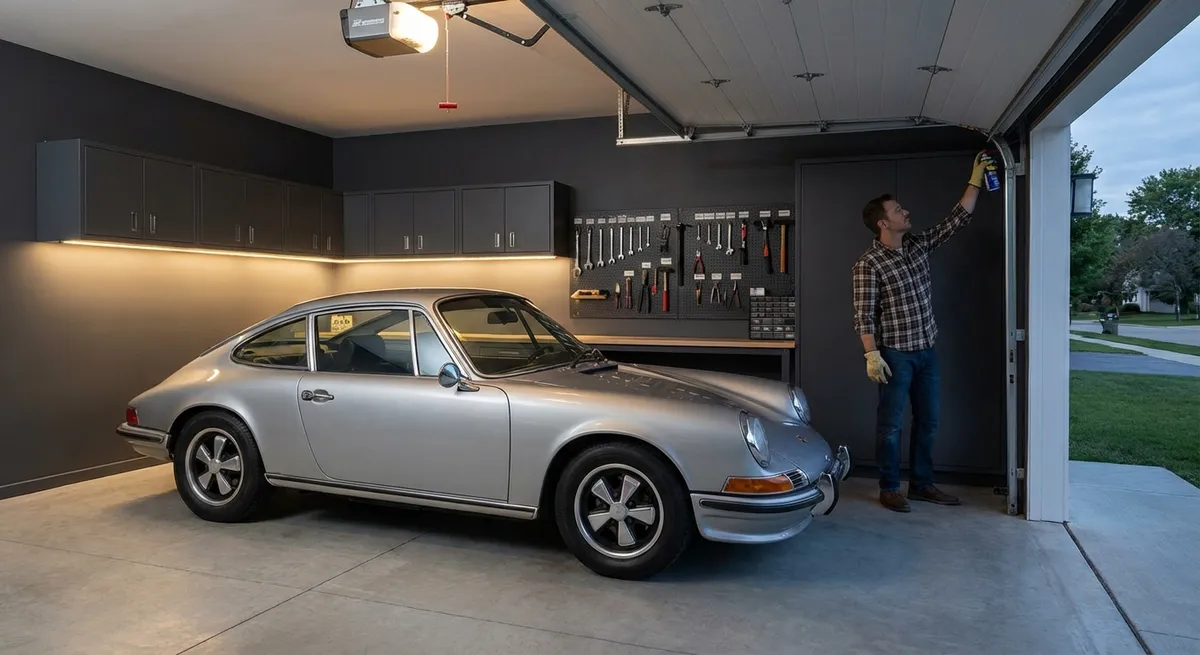
Standard advice stops at “oil the hinges and rollers,” but a premium maintenance approach begins with calibration. Before applying any lubricant, visually inspect the entire system in motion: watch the door’s travel from fully closed to fully open, noting any hesitations, asymmetrical movement, or visible flexing in the tracks. These are not mere quirks; they are early indicators of imbalanced spring tension or micro‑misalignments that put stress on the opener and shorten the life of cables, pulleys, and bearings. When lubrication is needed, use it intentionally: a dry silicone or lithium‑based product on rollers and hinges, a sparing application on torsion springs, and never on the tracks themselves, where excess product attracts dust and grit. After lubrication, test again and listen. The goal is not simply a quieter door—it is a more balanced mechanism where each component shares the load correctly, protecting both safety and longevity.
3. Manage the Microclimate: Temperature, Humidity, and Air Quality
The garage has its own microclimate, and how you manage it quietly dictates whether tools rust, finishes peel, and electronics fail prematurely. Instead of treating the space as semi‑outdoor, monitor it with the same precision you might use in a wine cellar or workshop. Install a simple digital hygrometer and review seasonal patterns: prolonged humidity above roughly 55–60% drastically accelerates rust on door hardware, track systems, and stored equipment. Strategic use of a dehumidifier, well‑placed weatherstripping, and properly sealed wall penetrations can stabilize the environment without over‑conditioning the space. For attached garages, this attention also protects indoor air quality; fumes and particulates from vehicles, paints, and solvents migrate more easily into living spaces than most homeowners realize. A disciplined approach to ventilation—quiet exhaust fans, controlled air gaps, and sealed door thresholds—ensures your garage functions as a protective buffer, not a hidden liability.
4. Treat the Opener as a Safety System, Not Just a Convenience
Garage door openers are often viewed as simple remote controls, but modern units are effectively safety systems managing substantial weight and kinetic energy. Testing them once a year is not enough if you value both security and reliability. Set a schedule to verify the auto‑reverse and photo eye sensors every quarter: a soft obstruction test (such as a roll of paper towels laid flat under the door) should trigger a clean reversal, not a stuttered, hesitant response. Misaligned sensors, frayed low‑voltage wiring, or erratic behavior are early warnings that the system is drifting out of spec, not “quirks” to ignore. In premium maintenance, you also treat the opener’s mounting as a structural element—inspect lag bolts into ceiling joists, any signs of vibration transfer, and the condition of the opener rail. Subtle reinforcements now prevent fatigue cracks, bracket failures, and the kind of abrupt breakdowns that often occur at the most inconvenient moment.
5. Establish a High‑Standard Maintenance Ritual, Not a One‑Time Fix
The most elegant garages do not remain that way by accident; they are governed by a quiet, recurring ritual. Instead of waiting for something to fail, apply a structured schedule that is tailored to how your garage is actually used. Heavy daily traffic, proximity to salt air, harsh winters, or frequent workshop activity all warrant more frequent inspections. Create a simple but elevated routine: quarterly visual and acoustic checks of the door and opener; seasonal attention to weatherstripping, thresholds, and drainage around the slab; and an annual “deep evaluation” of springs, cables, fasteners, and finishes. Document what you notice—changes in sound, closing speed, visible wear—so emerging issues are caught while they are still minor, inexpensive refinements rather than disruptive failures. This intentional cadence transforms garage care from reactive problem‑solving into a curated process that quietly preserves both performance and property value.
Conclusion
A truly refined home does not tolerate noisy mechanisms, inconsistent finishes, or unpredictable failures—especially in a space as frequently used as the garage. By approaching maintenance with calibration instead of guesswork, managing the microclimate instead of ignoring it, and treating each component as part of a cohesive system, you move beyond “basic upkeep” into a more deliberate standard of care. The result is subtle but unmistakable: a garage that opens, closes, stores, and protects with the graceful reliability of something that has been thoughtfully engineered—and just as thoughtfully maintained.
Key Takeaway
The most important thing to remember from this article is that this information can change how you think about Maintenance.