A garage door is often the largest moving element of a home, yet it is rarely treated with the same level of discernment as a kitchen renovation or bespoke cabinetry. For homeowners who expect more than basic function, the garage door becomes an intersection of engineering, aesthetics, acoustics, and security. This guide looks beyond the obvious “repair and replace” approach and focuses on subtle, high‑value decisions that elevate both performance and daily experience—especially if you’re already dealing with noise, misalignment, or unreliable operation.
Reframing the Garage Door as Architecture, Not Hardware
Seeing the garage door as part of the home’s architectural composition changes every decision you make—materials, finishes, glazing, and even track placement suddenly matter more.
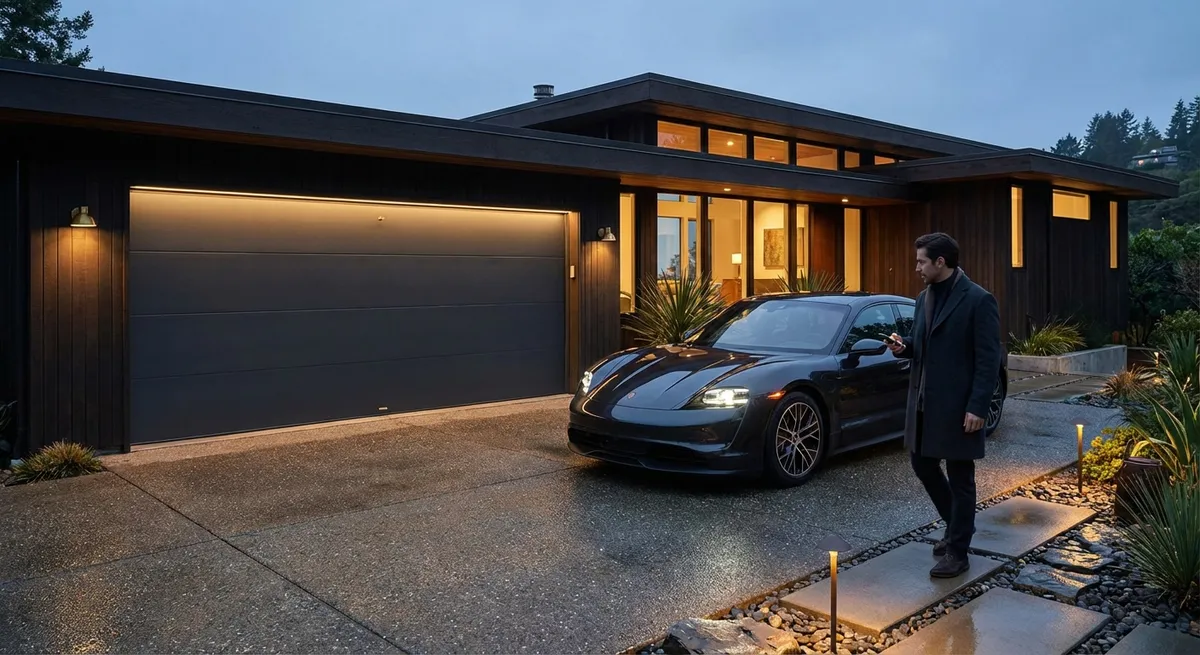
A poorly chosen replacement door can visually flatten an otherwise refined façade; a well‑considered one can add depth, rhythm, and proportion. For homes with prominent front‑facing garages, upgrading from stamped steel to flush or minimalist panel designs can instantly modernize curb appeal without compromising durability.
Beyond appearance, architectural thinking also addresses the door’s interaction with interior space. Low‑headroom tracks and wall‑mount openers can reclaim valuable ceiling volume for storage systems, lifts, or clean visual lines. For homeowners frustrated by clutter or awkward clearance, re‑specifying the track configuration often solves more issues than replacing the opener alone.
The most sophisticated repairs start with a holistic assessment: sightlines from the street, interior storage goals, sound transfer to living areas, and how the door will age alongside the rest of the home’s finishes.
Exclusive Insight #1: Weight Distribution Is the Hidden Source of Many “Mystery” Problems
Many homeowners focus on the opener when their garage door misbehaves, yet the true culprit is often poor weight distribution. When the door’s weight is not perfectly counterbalanced by the torsion springs and hardware, symptoms appear that seem unrelated.
A door that slams shut in the final few inches, struggles to open mid‑travel, or reverses unexpectedly may be signaling that the spring torque or cable tension is off, not that the opener is “weak.” Over time, an unbalanced door overworks the motor, stretches the chain or belt, and accelerates wear on rollers and hinges.
A refined repair plan begins with a balance test: with the opener disconnected, the door should remain in place when lifted to several positions (quarter, half, and three‑quarter open). If it drifts significantly up or down, spring adjustment or replacement is overdue. For heavier designer doors (solid wood, insulated glass, or oversized custom designs), this becomes even more critical; a minor miscalculation in spring sizing can be magnified by the added weight.
Insisting that your technician documents the spring specs, door weight, and balance test results gives you a technical baseline. For a discerning homeowner, this transforms a routine service call into a calibrated correction rather than a quick fix.
Exclusive Insight #2: Acoustic Comfort Starts with the Door, Not Just the Opener
A “quiet” opener alone cannot fully resolve garage noise that seeps into living spaces or disturbs bedrooms above. Acoustic comfort is a system outcome, and the door itself is the first variable to address.
Insulated doors—especially those with polyurethane foam cores—provide a noticeably different sound profile than hollow pan doors. They reduce exterior noise (traffic, neighbors, weather) and dampen the vibration of the door panels during operation. High‑quality nylon rollers and precision‑hinged hardware further limit rattling, which can be amplified through framing into adjacent rooms.
Mounting strategy matters as well. Rigid connections between opener and ceiling joists can transmit mechanical vibration directly into the structure. Vibration‑isolating mounts, rubber grommets, and carefully placed blocking can reduce this transfer significantly. This attention to detail is particularly important in multi‑story homes where bedrooms share structural elements with the garage.
For homeowners already contending with echoes, hum, or rattles, a truly premium solution layers several elements—door insulation, upgraded rollers, balanced springs, and isolated opener mounting—rather than relying solely on a “quieter” motor.
Exclusive Insight #3: Precision Alignment Protects Both Safety Systems and Finishes
When a garage door begins to rub against the frame, leave faint marks on the trim, or show uneven gaps at the sides, it is more than a cosmetic concern. Misalignment can confuse safety systems and quietly damage both the door and surrounding finishes over time.
Photo‑eye safety sensors are calibrated to detect obstructions, but they assume smooth, consistent travel. A misaligned or warped panel may cause the door to bind momentarily, leading the opener to interpret resistance as an obstacle and reverse unexpectedly. This is why some doors “change their mind” mid‑closing, even when the sensor lights are solid.
Refined repair work includes more than re‑tightening hardware. It involves checking vertical and horizontal track plumb and level, verifying that the jambs and header are true, and correcting any twist in the door sections. For heavier custom doors, reinforcing struts may be essential to preserve alignment under load over time.
For homeowners with painted or stained trim, persistent rubbing can subtly erode finishes and expose raw material, inviting moisture and eventual rot. Addressing alignment early is a strategic, long‑term protection of both function and craftsmanship.
Exclusive Insight #4: Security Upgrades Are Most Effective at the “Weakest Link”
Premium homes often invest in advanced security systems, yet many overlook the garage—particularly the transitions between garage and interior. The result is a sophisticated perimeter with an unexpectedly vulnerable gateway.
Modern openers with rolling‑code technology significantly reduce the risk of radio signal replay attacks, but that is only part of the picture. Older wall consoles with “lock” features are often unused; enabling them when you travel can disable remote access temporarily without affecting hardwired controls.
The service door from garage to home is commonly under‑specified: basic locksets, hollow‑core construction, and modest strike plates. Upgrading this single door to a solid‑core or metal unit with high‑security hardware often increases real protection more than replacing the entire overhead door. Motion‑activated, camera‑equipped smart openers add visibility, but their value is magnified when combined with strong physical barriers.
Windows in garage doors require similar selectivity. Frosted or obscure glass protects privacy while still allowing natural light; laminated or tempered options add resistance to forced entry. For homeowners already contending with neighborhood break‑ins, pairing an upgraded opener with reinforced interior entry doors, discreet glazing choices, and carefully set access codes yields a truly layered defense rather than a cosmetic one.
Exclusive Insight #5: Strategic Component Upgrades Outperform Full Replacement for Many Homes
When a garage door becomes unreliable, the default assumption is often full replacement. Yet for many high‑quality existing doors—especially those with solid construction or architectural detailing—a component‑focused upgrade plan can deliver near‑new performance with far less disruption.
Key wear items such as torsion springs, lift cables, rollers, and hinges typically reach the end of their service life before the panels themselves do. Replacing these components with higher‑grade options (e.g., extended‑cycle springs, sealed bearing rollers, heavy‑duty hinges) can not only restore smooth operation but also extend maintenance intervals significantly.
Openers are similar. A transition from an older chain‑drive unit to a modern DC belt‑drive or wall‑mount model can transform noise levels and introduce smart features—such as app control, activity logs, and integration with home automation systems—without altering the door itself. For homeowners already frustrated by inconsistent opening, limited range remotes, or lack of remote monitoring, this is a targeted, high‑impact upgrade.
The most refined approach begins with an honest evaluation of what is structurally sound versus what is functionally obsolete. Preserving a well‑crafted door while surgically replacing the under‑performing elements respects both the original investment and the home’s architectural integrity.
Conclusion
For homeowners who view their residence as a carefully managed asset rather than a collection of parts, the garage door deserves a more nuanced treatment than “it opens and closes.” When weight distribution is properly calibrated, noise is addressed as a system issue, alignment is viewed as both a safety and finishing concern, security is designed to protect the weakest link, and components are upgraded with intention, the garage ceases to be a functional afterthought.
Instead, it becomes a quiet expression of engineering competence and aesthetic restraint—an entrance that works flawlessly, looks considered, and feels as deliberately refined as the rest of the home.
Sources
- U.S. Department of Energy – Insulated Garage Doors - Explains the benefits of insulated doors for comfort, efficiency, and noise reduction.
- International Association of Certified Home Inspectors – Garage Door Safety - Details common safety issues, balance tests, and inspection points for garage doors.
- Consumer Product Safety Commission – Garage Door Opener Safety - Provides guidance on automatic reversal systems, sensors, and injury prevention.
- LiftMaster – Smart Garage Door Openers Overview - Outlines capabilities and advantages of modern smart openers for security and convenience.
- UL Solutions – Standards for Garage Door Operators (UL 325) - Describes safety standards governing automatic garage door and gate operators.
Key Takeaway
The most important thing to remember from this article is that this information can change how you think about Garage Doors.