A garage door is often the largest moving element of a home, yet for many properties it remains an afterthought—audible, conspicuous, and occasionally temperamental. For discerning homeowners, however, the garage door is treated as a crucial threshold: a daily touchpoint where engineering, quiet performance, and visual restraint converge. Addressing garage door issues is not merely about “getting it to work again,” but about restoring a sense of effortlessness every time the door moves.
This guide explores refined solutions to common garage door problems, with a particular focus on durability, discretion, and long-term value. The following five insights move beyond basic troubleshooting and into the realm of quiet excellence—where every adjustment has a purpose, and every repair is an opportunity to elevate the experience of arrival.
Rethinking Operation Noise: From Acceptable to Almost Imperceptible
Most homeowners tolerate noise until it becomes disruptive. A more elevated standard asks a different question: how soft can this system sound without compromising power or security?
The answer lies in treating noise as a system-level symptom, not a single-point failure. Metal-on-metal contact, dry rollers, misaligned tracks, and aging openers all contribute distinct tones—rattles, squeaks, low-frequency rumble. Swapping basic steel rollers for high-quality nylon ball-bearing rollers, for example, addresses both vibration and friction at once. Adding isolation pads beneath opener mounts can decouple motor vibration from ceiling joists, preventing the familiar “thud” that travels through bedrooms above.
A sophisticated approach brings these adjustments together: carefully tuned spring balance, properly torqued hardware, corrected track alignment, and a modern, belt-drive opener working in unison. The result is a door that no longer announces itself, but simply moves—decisively, quietly, and with mechanical confidence.
Precision Balancing: Protecting the Opener by Perfecting the Counterweight
Many garage door issues presenting as “weak opener,” “sluggish operation,” or “random reversals” are, in reality, balance problems. A well-balanced door can be lifted by hand with minimal effort and should remain in position when stopped mid-travel. Anything else signals that the counterweight system—springs, cables, and hardware—is working against the opener rather than with it.
Torsion and extension springs are calibrated to the weight and dimensions of the door. When they fatigue, the opener begins acting as a lifting device instead of a guide and controller. This accelerates wear on drive gears, belts, and motor components, introducing intermittent failures long before full breakdown.
A premium repair strategy always starts with load equilibrium: measuring the door’s effective weight, checking cable condition and drum seating, verifying spring sizing and tension, and ensuring that the opener is doing exactly the work it was designed for—no more, no less. Proper balance does more than “fix” a door; it restores smoothness, protects investment in the opener, and materially extends service life.
Intelligent Materials Choices: When an Upgrade Solves More Than One Problem
For many homes, the garage door is both a design statement and a performance asset. A strategic material change can resolve recurrent issues—warping, corrosion, strain on hardware—while elevating visual presence.
Older, heavy wood doors often look impressive but impose significant mechanical load. Retrofitting them with modern, steel-backed insulated sections can maintain a similar aesthetic through high-quality finishes and faux-wood textures, while reducing weight and improving thermal performance. Lightweight, poorly insulated doors at the other end of the spectrum may invite condensation in the garage, foster surface rust, and strain components due to panel flex.
The refined approach is to view the door as part of the building envelope: selecting insulated, properly reinforced sections with hardware-rated wind load where appropriate, corrosion-resistant hinges and fasteners, and seals compatible with local climate. Thoughtful material choices solve subtle functional annoyances—drafts, temperature swings, minor leaks—while also providing a crisper, more tailored façade that resonates with the rest of the architecture.
Silent Reliability: Hardware Details That Separate “Working” from “Exceptional”
A garage door can function while still feeling imprecise: small jerks in motion, faint clatter at joints, a slight shudder at the top of travel. These micro-irritations are often the cumulative effect of inexpensive or fatigued hardware that is technically operable but far from refined.
Premium hinges with thicker gauge steel reduce panel movement and twist, keeping sections aligned and quiet. Upgraded rollers with sealed bearings glide rather than scrape along the track, keeping motion linear and controlled. Precision track alignment, with small corrections to plumb and reveal, minimizes binding and contact points that cause both noise and early wear.
Even the choice of fasteners matters. Self-tapping screws installed once and left to work themselves free over years of vibration create intermittent creaks and looseness. Stainless or high-grade fasteners, properly torqued and occasionally rechecked, deliver a door that feels composed—every time it opens, the motion is predictable, linear, and free from distractions.
Discreet Smart Integration: Technology That Serves, Not Dominates
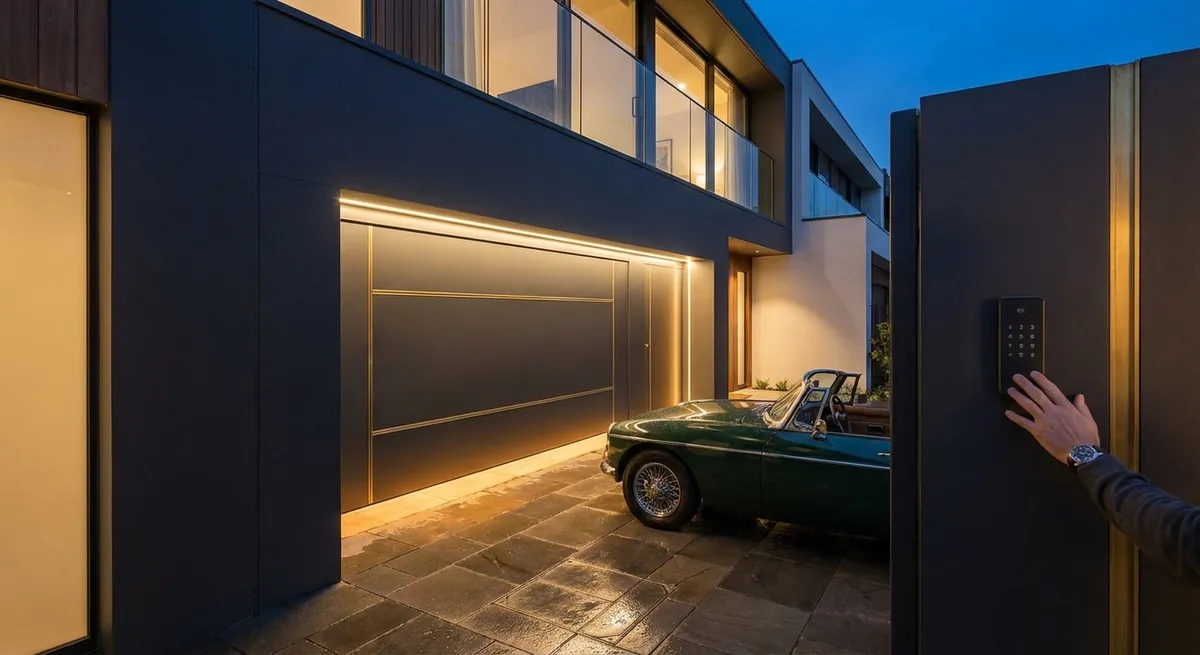
For many homeowners, the garage door is now the primary entry point, making intelligent control more than a novelty. The difference between basic “smart” functionality and a truly elevated system lies in subtle integration and dependable security.
Smart openers that offer encrypted radio signals, rolling codes, and secure app access help protect against unauthorized entry while allowing controlled digital convenience. Features such as real-time status monitoring, activity logs, and remote closure are particularly valuable for those who travel often or manage multiple properties. A door left slightly open is no longer a lingering question; it’s a quick glance at a trusted app.
The key is to choose technology that disappears into daily life. Quiet motors, soft-start/soft-stop operation, discreet wall controls, and cleanly routed safety sensors preserve the simplicity of the physical space while delivering sophisticated control behind the scenes. Repairs and upgrades should be selected not only for capability, but for how gracefully they integrate with the home’s existing rhythms.
Conclusion
A garage door in its best form is a study in restraint: powerful but quiet, complex yet effortless, large in scale but almost invisible in day-to-day thought. Addressing persistent issues with a refined mindset—focusing on balance, materials, hardware precision, acoustic performance, and discreet technology—transforms a utilitarian necessity into a quietly satisfying part of every arrival and departure.
For homeowners who demand more than the merely functional, the garage door becomes another expression of the home’s overall standard: carefully maintained, deliberately specified, and tuned to operate not just reliably, but beautifully.
Sources
- U.S. Consumer Product Safety Commission – Garage Door Opener Safety – Overview of safety features, entrapment protection, and federal requirements for modern openers
- International Association of Certified Home Inspectors – Garage Door Inspections – Technical guidance on door balance, hardware, and inspection best practices
- Clopay Garage Doors – Garage Door Construction & Insulation Guide – Detailed explanations of materials, insulation levels, and performance considerations
- LiftMaster – Smart Garage Door Opener Features – Information on quiet-drive systems, smart integration, and security technologies
- U.S. Department of Energy – Attached Garages and Energy Efficiency – Insight into how garage doors and attached garages affect home comfort and energy performance
Key Takeaway
The most important thing to remember from this article is that this information can change how you think about Garage Doors.