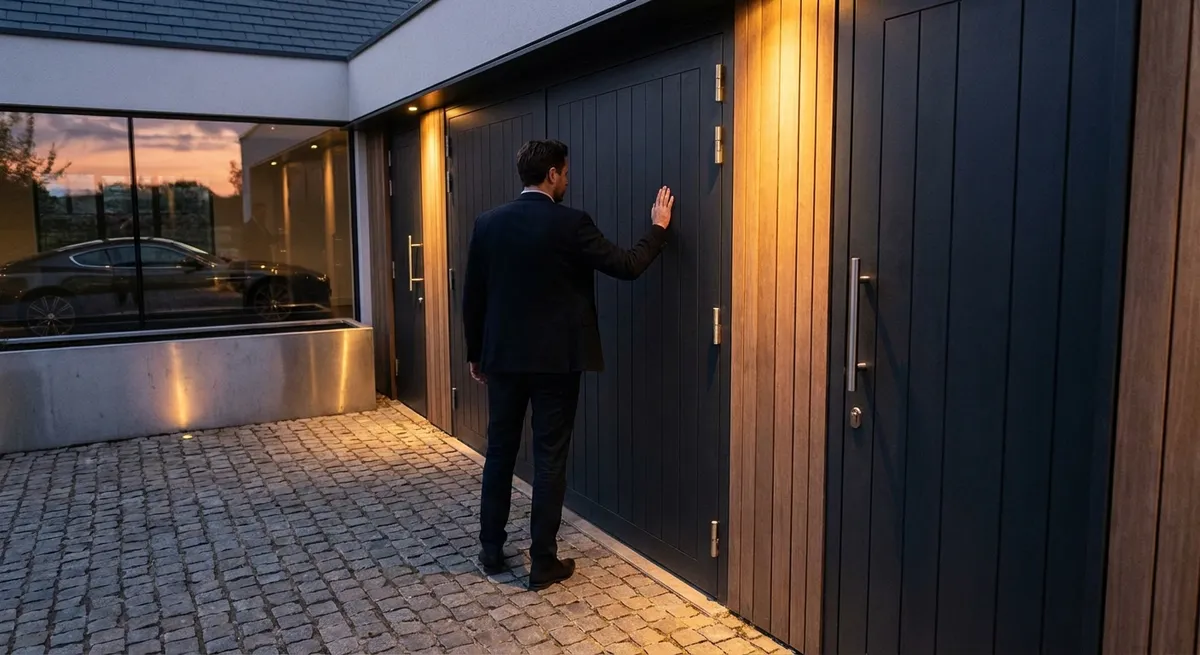
A garage door is often the largest moving element of a home—and one of the least thoughtfully curated. For households that expect quiet reliability and refined function, a misaligned track or a harsh, metallic rattle is more than a nuisance; it is an affront to the overall experience of the property. This guide is crafted for homeowners who view their garage door not as a purely utilitarian object, but as a precision system worthy of the same consideration given to a well‑tuned automobile or a bespoke entryway.
Below are five exclusive, detail‑oriented insights that go beyond generic maintenance tips—insights that speak to durability, acoustics, and the subtle performance cues only a discerning owner truly notices.
1. The Sound Signature of a Well‑Tuned Door
Every garage door has a sound signature—a combination of motor hum, roller contact, and panel movement. Learning that sound signature and noticing slight deviations is one of the most refined diagnostic tools at your disposal.
A door that begins to emit a hollow thud at mid‑travel, a faint ticking near the header, or a new vibration in the adjoining room is often signaling a problem far earlier than visible wear. These can indicate:
- Micro‑shifts in track alignment
- Early bearing or roller wear
- Fasteners beginning to loosen under cyclical load
- Springs starting to lose uniform tension
Instead of waiting for a catastrophic failure (or an embarrassing stuck door before a departure), take changes in acoustics as a prompt for a quiet inspection. A high‑quality silicone lubricant applied judiciously to hinges and rollers, verification of lag screws into the header, and a quick check for track plumb and level can restore the door’s original sound profile—and prevent far more serious repairs.
2. Precision Balancing: The Invisible Foundation of Door Longevity
Balance is the unseen metric that determines how gracefully a door moves and how long the opener will last. A perfectly balanced door feels lighter than it looks and can be moved manually with minimal effort and no sudden drifting.
A refined balance check involves:
- Disengaging the opener using the manual release (with the door closed).
- Lifting the door to three distinct positions: about 1/3 open, 1/2 open, and 2/3 open.
- Releasing gently and observing behavior.
A properly balanced door will remain nearly stationary at each point, perhaps with the slightest, slow drift. If it snaps open, slams shut, or won’t stay mid‑way, the torsion or extension springs are no longer providing calibrated support.
Why this matters to a discerning homeowner:
- An unbalanced door dramatically stresses the opener, shortening its lifespan.
- It increases wear on the drive system, rails, and internal gears—often the quietest forms of damage until it is too late.
- It subtly alters the motion path, leading to rail deflection and accelerated roller wear.
Spring adjustment is not a do‑it‑yourself task for most homeowners—torsion springs store significant energy and must be set with specialized tools and training. However, knowing how to identify imbalance allows you to call a qualified technician before the system reaches a failure point, preserving both safety and the refined ease of everyday use.
3. Hardware Selection: Why Rollers, Hinges, and Tracks Deserve an Upgrade
Most builder‑grade garage door systems arrive with the bare minimum: rigid metal rollers, basic stamped hinges, and standard track assemblies. They function, but they do very little for quiet operation, smooth movement, or long‑term durability.
Strategic hardware upgrades can transform the door’s character without changing its appearance:
- Nylon or sealed-bearing rollers: These substantially reduce noise and vibration compared to standard metal rollers. They also tend to track more smoothly, placing less torsional strain on hinges and tracks.
- Heavy‑gauge hinges: Upgrading to thicker, precision‑stamped hinges at high‑stress locations (often at the middle panels) prevents play in the joints, which is a major source of chatter and misalignment over time.
- Reinforced top brackets and struts: A properly braced top panel resists flexing when the opener pulls the door upward, which both quiets motion and preserves the panel’s structural integrity, particularly on wide double‑bay doors.
These components are modest investments relative to the cost of a full new door, yet they offer a noticeable elevation in daily experience. For homeowners who care about tactile and acoustic refinement, hardware quality is the difference between a door that simply “works” and one that operates with the composed assurance of a well‑engineered system.
4. Environmental Calibration: Humidity, Temperature, and Seal Strategy
A premium garage door installation is not merely mechanical—it’s environmental. Seasonal changes in humidity and temperature subtly affect the door’s performance, the frame, and even the adjoining living spaces.
Consider the following refinements:
- Weatherstripping as a dynamic element, not an afterthought. The bottom seal, side seals, and top seal should create a coherent barrier. Upgrading to a higher‑quality rubber or vinyl with proper durometer (firmness) ensures a tight seal without excessive friction that strains the opener.
- Thermally efficient doors in mixed climates. Insulated doors with a higher R‑value can help moderate temperature swings in the garage, protecting vehicles, stored items, and even mechanical systems such as water heaters that may share the space. The resulting thermal stability often reduces condensation on metal components, extending their life.
- Monitoring wood framing movement. In older homes, the jambs and header can subtly shift seasonally, tightening clearances. Slight track adjustments—rather than over‑tightening hardware to “fight” the frame—maintain smooth travel as the structure subtly moves with weather patterns.
By approaching your garage door as part of the home’s environmental envelope, you reduce drafts, manage dust and moisture, and preserve finishes inside the garage. The result is a cleaner, more temperature‑stable, and more acoustically controlled space.
5. Opener Intelligence: Tuning Force, Speed, and Sensitivity with Intention
Modern openers offer a level of adjustability that many homeowners never take advantage of. For a premium experience, it is worth tailoring the opener’s settings to the specific door, the home, and your priorities.
Key adjustments that yield disproportionately refined results:
- Closing force and sensitivity: Properly adjusted, the door should reverse decisively if it encounters resistance, but not chatter or bounce at the floor due to excessive speed or force. Overly strong settings can mask underlying friction problems; overly sensitive settings cause nuisance reversals.
- Soft‑start and soft‑stop features: Higher‑end openers can ramp motor speed up and down instead of abrupt starts and stops. When correctly set, this not only sounds more elegant but also reduces mechanical shock to the door, tracks, and mounting points.
- Speed settings matched to door size and use: A massive double door doesn’t need to move at maximum speed; a slightly slower, controlled travel reduces noise and component fatigue. A smaller, well‑balanced single door can be allowed a slightly quicker motion without penalty.
- Lighting logic: Integrated LED lighting can be configured to illuminate only as long as needed and may be tied to motion detection—providing a carefully orchestrated lighting sequence when you arrive, rather than a harsh all‑or‑nothing burst.
Having a professional perform an opener “tuning session” every few years—where limit settings, force levels, travel speed, and safety sensors are calibrated together—elevates the entire system. You are left with a door that behaves predictably and gracefully, almost as if it anticipates your routines.
Conclusion
A garage door in a demanding home should do more than merely open and close; it should move with poise, sound composed, and age slowly and predictably. By attending to its sound signature, insisting on precise balance, selecting elevated hardware, calibrating it to your environment, and intentionally tuning the opener, you transform a common system into a quietly sophisticated asset.
For discerning homeowners, these details are not indulgences; they are the foundation of a residence that functions as elegantly as it appears. The garage door becomes not the weak link in the experience of arrival—but an integral, well‑crafted part of it.
Sources
- U.S. Consumer Product Safety Commission – Garage Door Safety – Official guidance on garage door opener safety features and proper operation
- International Door Association (IDA) – Garage Door Maintenance Tips – Professional trade association recommendations on balancing, hardware inspection, and routine care
- Clopay – Garage Door Insulation and Energy Efficiency – Manufacturer information on insulated doors, R‑values, and the impact on home comfort
- LiftMaster – Garage Door Opener Features and Safety – Detailed explanation of modern opener force, sensitivity, and safety settings
- Cornell University – Noise and Vibration Basics – Background reference on noise, vibration, and how mechanical systems transmit sound through structures
Key Takeaway
The most important thing to remember from this article is that this information can change how you think about Garage Doors.