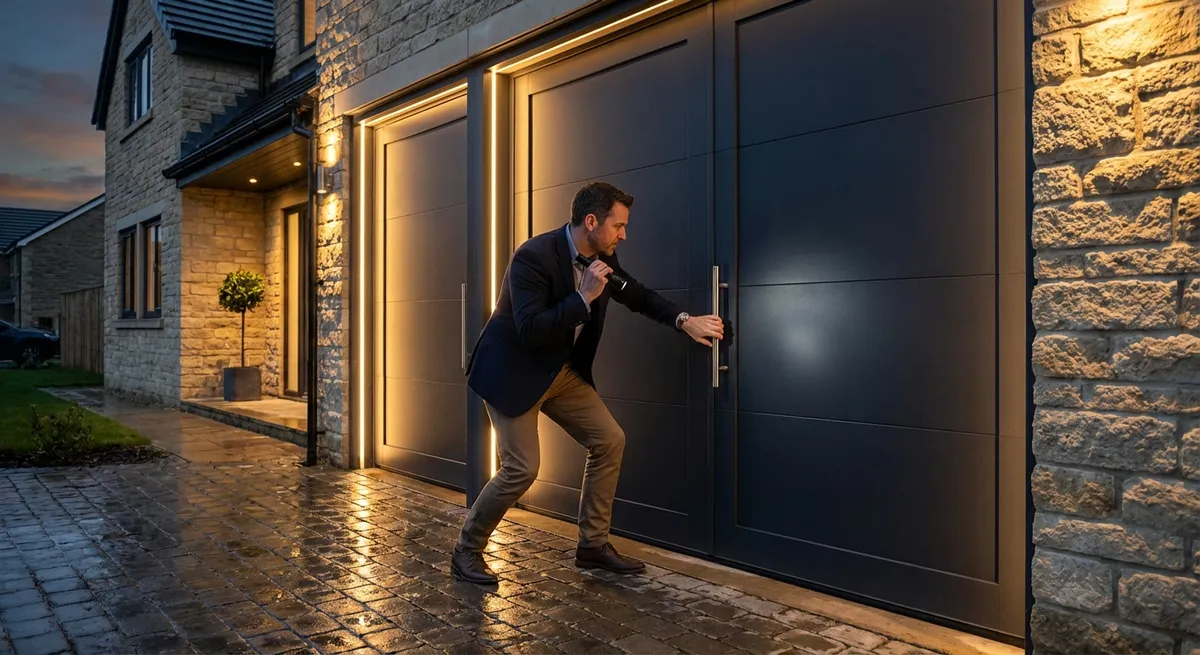
A garage door is often the largest moving element of a home, yet it’s also the one most frequently reduced to a mere utility. For homeowners who expect quiet refinement, reliable motion, and a polished façade, the garage door deserves a more deliberate approach. When it begins to rattle, hesitate, or show uneven wear, it’s not only an inconvenience—it’s a signal that precision, safety, and aesthetics require renewed attention.
This guide explores how to restore and refine your garage door with a standard that goes beyond “working” and moves toward “effortless.” Within it are five exclusive insights—practical, but with an eye for detail—that help you resolve issues with the same care and discernment you bring to the rest of your home.
Reading the Door: How Sophisticated Homeowners Diagnose Issues
Polished garage door performance begins with the ability to read subtle clues. Most failures do not arrive suddenly; they announce themselves quietly, through sound, motion, and visual irregularities.
Listen first. A well-tuned door is composed and muted. New clattering, metallic scraping, or a staccato rattle often indicates loose hardware or fatigued rollers. A rising “whine” suggests an opener under strain, often because of misaligned tracks, poor lubrication, or weakened springs. Any loud bang, particularly when the door is still, may be a sign of a torsion spring breaking—a serious safety concern that warrants immediate professional attention.
Then, watch. A refined garage door moves in one confident, unhurried arc. If your door jerks on the way up, hesitates mid-travel, shudders at the top, or closes with an abrupt final drop, it’s telling you that balance, track alignment, or opener force settings are in question. Stand back and observe from outside: does the bottom seal meet the floor evenly? Are the gaps between panels uniform? These details often reveal problems long before they become true failures.
Finally, feel. When you operate the door manually (with the opener disengaged), it should lift smoothly and remain roughly in place when positioned halfway open. If it races downward or feels excessively heavy, the counterbalance system is no longer properly calibrated—a refined home requires that this be corrected by a trained technician, both for safety and to protect the door and opener from accelerated wear.
Exclusive Insight 1: Precision Balance is the Hidden Luxury Feature
To most homeowners, a garage door that “goes up and down” seems acceptable. To a discerning owner, the true standard is balance. A perfectly balanced door behaves as though it almost floats—neither surging upward nor collapsing downward when moved manually. This balance is not simply an aesthetic preference; it is the cornerstone of quiet, graceful, and long-lived operation.
When a door is out of balance, the opener is forced to compensate, acting less like a control system and more like a lifter. This hidden strain shortens motor life, damages gears, and can cause modern openers to stop mid-travel or reverse unexpectedly as safety circuits interpret the extra drag as an obstruction. A properly balanced door, by contrast, allows the opener to operate with minimal effort, resulting in reduced noise, smoother motion, and far less mechanical fatigue.
Correcting balance is not a DIY adjustment. It requires calibrating torsion or extension springs under significant tension, with specialized tools and a trained understanding of force. What you can—and should—do is insist that any service visit includes a precise balance test, not just a superficial check that the door “moves.” This single detail is often the difference between a merely functional door and one that feels genuinely refined every time it opens.
Exclusive Insight 2: Hardware Quietness Begins with the Right Materials
Many homeowners chase silence through the opener alone, choosing a belt-drive unit or a quieter motor. While this matters, the true foundation of a quiet, composed garage door is mechanical hardware—particularly rollers, hinges, and fasteners.
Standard steel rollers with worn or dry bearings become small percussion instruments, amplifying every vibration into the track. Upgrading to high-quality nylon rollers with sealed bearings can transform the character of the door: motion becomes smoother, noise drops noticeably, and the opener no longer has to overcome microscopic jolts at every panel junction. These upgrades are subtle in appearance, but striking in day-to-day use.
Hinges and brackets deserve equal scrutiny. Over time, mounting screws can loosen, creating a chorus of rattles that no opener can fully mask. A refined hardware inspection doesn’t just tighten these fasteners; it evaluates for elongation of screw holes, hairline cracks in hinges, and minor track deformation. Replacing fatigued components before they fail prevents sudden, disruptive issues and preserves the quiet assurance that defines a well-maintained home.
The result is a door that doesn’t just “work”—it moves with a sense of engineered calm, similar to the closing of a well-crafted cabinet rather than the slam of a utility gate.
Exclusive Insight 3: Environmental Sealing is About More Than Drafts
Weatherstripping is often seen as a minor comfort upgrade—something to reduce drafts or keep leaves at bay. For a homeowner who views the garage as an extension of the home, sealing is a far more strategic element.
First, well-designed perimeter and bottom seals protect the door system itself. By reducing moisture infiltration, they help defend against corrosion at the lower tracks, fasteners, and the door’s bottom panel, which is typically the first to show age. This is especially important with steel or wood doors in climates prone to condensation or road salt exposure. Over several seasons, high-quality seals preserve both appearance and structural integrity.
Second, better sealing stabilizes interior temperatures, which makes any adjacent living spaces more comfortable and lowers energy demand on the rest of the home. If utilities pass through your garage, or if you store sensitive items—tools, finishes, equipment—consistent conditions matter. In this context, upgrading to insulated doors and robust sealing becomes a meaningful part of the home’s overall thermal strategy, not just a comfort nicety.
Finally, effective sealing significantly improves cleanliness and acoustics. Dust, insects, and street noise are inhibited, making the garage feel less like a buffer zone and more like a deliberate, usable space—whether that’s for a vehicle collection, a workshop, or simply refined storage. The simple visual of a door closing to reveal a uniform, well-fitted seal across floor and frame subtly telegraphs quality every time you arrive home.
Exclusive Insight 4: Opener Intelligence Only Matters When It’s Properly Tuned
Smart garage door openers promise convenience—phone control, remote monitoring, integration with broader home systems. But in many homes, the intelligence stops at installation. Without careful tuning and periodic recalibration, even the most advanced opener becomes a blunt instrument.
Modern openers typically include adjustable force and travel settings, as well as safety reverse systems governed by both force sensing and photoelectric sensors. If these settings are left too high, the door can close with unnecessary aggression, masking underlying balance or track issues while stressing the structure. If set too low, minor friction increases can cause nuisance reversals that erode confidence in the system.
A refined setup treats opener settings as precision adjustments, not guesses. Travel limits are calibrated so the door seals firmly—without overdriving into the floor or header. Force settings are tuned to the minimum necessary to move a properly balanced door, not to overcome its flaws. Photo-eye sensors are aligned with care, their lenses kept clean and their wiring inspected to avoid intermittent failures.
This is also where smart features can be used with sophistication rather than novelty. Scheduled closing can ensure that doors never remain inadvertently open overnight. Activity logs can reveal subtle changes in operation frequency or unexpected attempts that may justify attention. Integration with exterior lighting can turn each arrival into a composed, intentional moment instead of a hurried routine.
The technology is the same hardware many people own; the difference lies in the standards you demand for its setup and ongoing calibration.
Exclusive Insight 5: Aesthetic Restoration is a Structural Investment
Refining the exterior of a garage door—its finish, hardware style, and visible details—is often framed purely as curb appeal. For homeowners attentive to longevity and function, aesthetics and structure are intertwined.
Coatings do more than beautify; they shield. A high-quality, properly applied finish resists UV degradation, moisture intrusion, and minor abrasions. This is especially critical for wood doors and for steel doors in coastal or high-humidity environments. Neglecting fading or flaking paint doesn’t just dull appearance; it often signals that protective layers have been compromised, allowing subtle warping, rust, or delamination to begin.
Attention to trim and surrounding elements is equally significant. Misaligned jambs, deteriorated framing, or cracked stucco around the opening can gradually distort track alignment, introducing operational problems that no amount of internal adjustment can fully correct. When you restore or upgrade the door, evaluating the framing as part of the project ensures that the new or refreshed door operates within a structurally sound aperture.
Even decorative hardware, when chosen and installed thoughtfully, can support performance. Corrosion-resistant handles and hinges reduce staining and weakening at mounting points. Architectural harmony—matching the door’s lines with the home’s style—elevates the perceived value of the entire façade. In upscale neighborhoods, a meticulously restored garage door often becomes a quiet differentiator, conveying care and intention before a guest ever reaches the front door.
Conclusion
A garage door that merely responds to a button press is common. A garage door that moves with poised precision, stays quietly in balance season after season, resists the elements, and harmonizes with the architecture of your home is something else entirely.
By paying attention to balance, hardware quality, environmental sealing, intelligent opener tuning, and aesthetic restoration, you transform an overlooked utility into a refined mechanism that serves you day after day with understated excellence. Each of these five insights is modest on its own; together, they define a standard of care that protects your investment, elevates daily experience, and reinforces the sense that everything in your home has been considered with intention.
Sources
- U.S. Consumer Product Safety Commission – Garage Door Safety – Official guidance on garage door opener safety standards and injury prevention
- International Association of Certified Home Inspectors – Garage Doors and Openers – Detailed overview of inspection points, balance testing, and common defects
- Clopay Garage Doors – Insulated vs. Non-Insulated Doors – Manufacturer insight into thermal performance and construction differences
- U.S. Department of Energy – Attached Garage Efficiency Considerations – Explains how garages affect whole-home energy use and comfort
- LiftMaster – Safety Reversal System and Maintenance Tips – Describes modern opener safety features and proper testing methods
Key Takeaway
The most important thing to remember from this article is that this information can change how you think about Garage Doors.