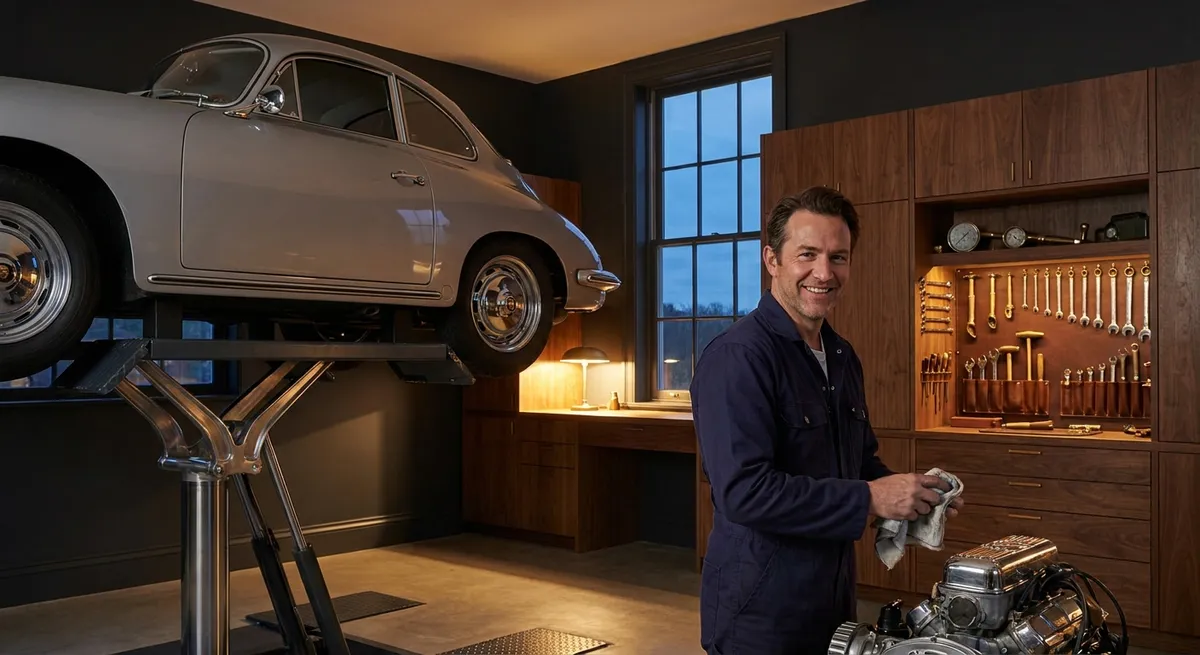
A well‑kept garage is rarely an accident. Behind every door that glides without protest and every floor that bears weight without complaint lies a series of deliberate repair decisions—quiet, precise, and deeply considered. For homeowners who expect more than basic functionality, garage repair is not a chore; it is an ongoing refinement of a space that protects valuable vehicles, tools, and, increasingly, lifestyle. This guide explores repair solutions with the same care you bring to the rest of your home, highlighting exclusive insights that elevate your garage from “working” to “impeccably resolved.”
The Hidden Architecture of a Reliable Garage Door
A garage door that opens smoothly on a winter morning or in a coastal storm is the result of more than luck. Its performance depends on a calibrated relationship between springs, tracks, cables, hinges, and opener settings—each component influencing the others. Repair work that treats issues in isolation (a squeak here, a misalignment there) often leads to recurring problems, while a systemic approach creates lasting stability.
When diagnosing issues—banging sounds, uneven travel, sagging sections—sophisticated repair begins with the door’s “geometry.” Tracks must be plumb and parallel, hinges correctly sized, and rollers matched to both door weight and track design. A door panel that flexes, even slightly, can telegraph stress into hinges and hardware, shortening their service life.
Professional‑grade repair also pays attention to fastener quality and placement. Cheap, soft-metal screws can loosen under vibration, while high‑quality lag screws set properly into framing preserve alignment under daily use. Reinforcement brackets at the top section, particularly where the opener arm connects, are a hallmark of a garage door that resists fatigue over time. The result is not simply a quieter door, but a more composed, structurally confident system that feels—and remains—under control.
Five Exclusive Insights Discerning Homeowners Rarely Hear
Beyond the typical advice about lubrication and visual inspection, refined garage repair involves a handful of strategic decisions that rarely make it into basic guides. These five insights can significantly influence both performance and long‑term resilience.
1. Torsion Spring Balancing Is a Performance Upgrade, Not Just a Repair
Most service calls treat spring replacement as a binary issue: broken or intact. In reality, the more telling question is whether your door is properly balanced. A well‑balanced door, when disconnected from the opener, should hover at about waist height without slamming shut or drifting open. Anything else places unnecessary strain on the opener motor and drive system.
Premium repair work often includes fine tuning torsion spring tension to match the exact weight and construction of your door—especially if you’ve upgraded to insulated panels, decorative hardware, or impact‑rated doors that alter overall weight. This balancing act transforms how the system feels: the opener no longer labors, the start/stop motion is cleaner, and the entire movement becomes more composed. Done correctly, it can significantly extend the life of your opener and hardware, while also improving safety.
2. Hardware Metallurgy Matters More Than Brand Labels
Homeowners often focus on the brand of the door or opener, but the quieter secret is in the hardware metallurgy. Inferior hinges and brackets made from thin or low‑grade steel can warp or elongate screw holes under repeated stress, leading to subtle misalignment that accumulates over years.
Opting for heavy‑gauge, corrosion‑resistant hardware (particularly in coastal or high‑humidity regions) changes the long‑term trajectory of your repairs. Stainless or galvanized steel components on critical points—bottom brackets, top fixtures, and center bearing plates—resist deformation and rust, preserving alignment and safety. When planning repairs or replacements, ask specifically about metal thickness, coating type, and cycle rating. A slightly higher initial spend often prevents the cascade of micro‑failures that lead to more invasive repairs later.
3. Opener Configuration Is as Important as Opener Model
Many households invest in a high‑end garage door opener and then live with suboptimal settings. The result is a capable device constrained by thoughtless configuration. Travel limits, force sensitivity, and speed profiles can be tuned to the specific door, hardware condition, and even climate.
Fine‑tuned force settings ensure the opener reacts appropriately to obstructions without becoming hypersensitive to minor resistance or temperature‑related stiffness. On belt‑drive or direct‑drive units, speed and soft‑start / soft‑stop features can be calibrated to minimize stress on older doors while still delivering confident movement. Integrating battery backup and smart controls is only genuinely valuable when the mechanical fundamentals—balance, track alignment, and correct opener mounting height—are properly resolved. The most refined repair solution treats configuration as a bespoke fitting, not a factory default.
4. Floor, Threshold, and Seal Repairs Are a Moisture Strategy—Not Just Draft Control
Water and moisture management around a garage is often seen as a comfort issue, when it is actually a preservation strategy. A small gap under the door, a cracked floor where water pools, or a compromised bottom seal can accelerate corrosion of door hardware, oxidation of tools, and deterioration of stored items.
A sophisticated repair plan might include laser‑level assessment of the floor slope, strategic grinding or resurfacing to remove low spots where water lingers, and the installation of a high‑quality threshold seal that pairs correctly with the door’s bottom retainer profile. In some cases, a slightly taller retainer with a dual‑lip seal can transform a chronic water intrusion issue into a controlled, predictable barrier.
This approach borrows from building‑envelope thinking: your garage is not an afterthought; it’s an extension of the home’s protection system. By treating moisture as a structural adversary, not just a comfort nuisance, you avoid slow‑motion damage that often masquerades as “age” or “wear.”
5. Strategic Zoning: Not Every Garage Surface Should Be Repaired Equally
Sophisticated repair strategy recognizes that not all surfaces and systems deserve identical investment. Instead of uniformly “upgrading everything,” disciplined homeowners focus on zones that deliver the greatest return in function, safety, and longevity.
High‑impact zone: door system, opener, tracks, springs, and safety sensors. These justify premium components and professional calibration.
Environmental zone: floor, weatherstripping, wall penetrations, and ceiling interfaces. Targeted repairs here control moisture, fumes, and temperature swings, indirectly preserving vehicles and stored items.
Utility zone: outlets, lighting, and mechanical supports (such as mounting points for storage or lifts). Repaired and reinforced correctly, they allow the garage to serve as workshop, charging bay, or hobby space without overtaxing circuits or stressing framing.
By deliberately over‑engineering the critical zones and applying “good enough” repairs to low‑risk areas (such as minor interior scuffs or non‑structural shelving), you allocate your repair budget in a way that mirrors how luxury properties are maintained: emphasis where it meaningfully affects experience and preservation.
Repair Solutions That Respect Safety, Code, and Quiet Confidence
Behind every refined repair decision should be an insistence on safety and compliance that is neither negotiable nor performative. Modern garage systems carry significant forces—torsion springs are under high load, doors are heavy, and openers interface with electrical systems and, increasingly, networked security.
A premium approach to repair solutions starts by acknowledging where professional intervention is essential. Adjusting torsion springs, tensioning high‑lift systems, or replacing lift cables are tasks that combine substantial mechanical energy with the potential for serious harm if mishandled. A reputable technician will not only carry appropriate certifications and insurance, but will also be familiar with local building codes, wind‑load requirements, and safety standards for entrapment protection.
Equally important is the integration of newer safety technologies into legacy systems. Photo‑eye sensors should be correctly aligned, mounted at compliant heights, and tested regularly. Auto‑reverse mechanisms must be validated, not assumed. Where older units lack modern safety features, replacement is often the most intelligent “repair.”
Finally, the most satisfying repair solutions are often the least conspicuous. A door that no longer rumbles through the house before dawn, an opener whose chain no longer sags, a threshold that prevents the faint sheen of water after every storm—these are subtle, cumulative wins. They don’t announce themselves, but they recalibrate what you consider “normal” every time you arrive home.
Conclusion
A garage that simply functions is common; a garage that operates with quiet assurance and structural composure is the result of intentional choices. By seeing repair not as crisis control but as refinement, you elevate an often overlooked space into one that matches the standard of the rest of your home. From precisely balanced springs to moisture‑aware thresholds and thoughtfully configured openers, each decision builds towards a garage that protects, performs, and endures.
When issues arise, consider them invitations—not to patch, but to improve. The most rewarding repair solutions are those that leave your garage not merely “fixed,” but quietly, confidently better than it has ever been.
Sources
- U.S. Consumer Product Safety Commission – Garage Door Safety Alert – Overview of safety concerns and requirements for automatic garage door openers
- International Association of Certified Home Inspectors – Garage Door Inspections – Technical details on garage door components, balance, and inspection points
- Clopay Garage Doors – Understanding Garage Door Springs – Manufacturer guidance on torsion and extension springs, balance, and replacement considerations
- LiftMaster – Safety Reversal System and Sensor Information – Official documentation on opener force settings, photo‑eyes, and safety features
- Federal Emergency Management Agency (FEMA) – Garage Doors and Wind Pressure – Engineering perspective on garage door reinforcement, structural performance, and code‑related recommendations
Key Takeaway
The most important thing to remember from this article is that this information can change how you think about Repair Solutions.