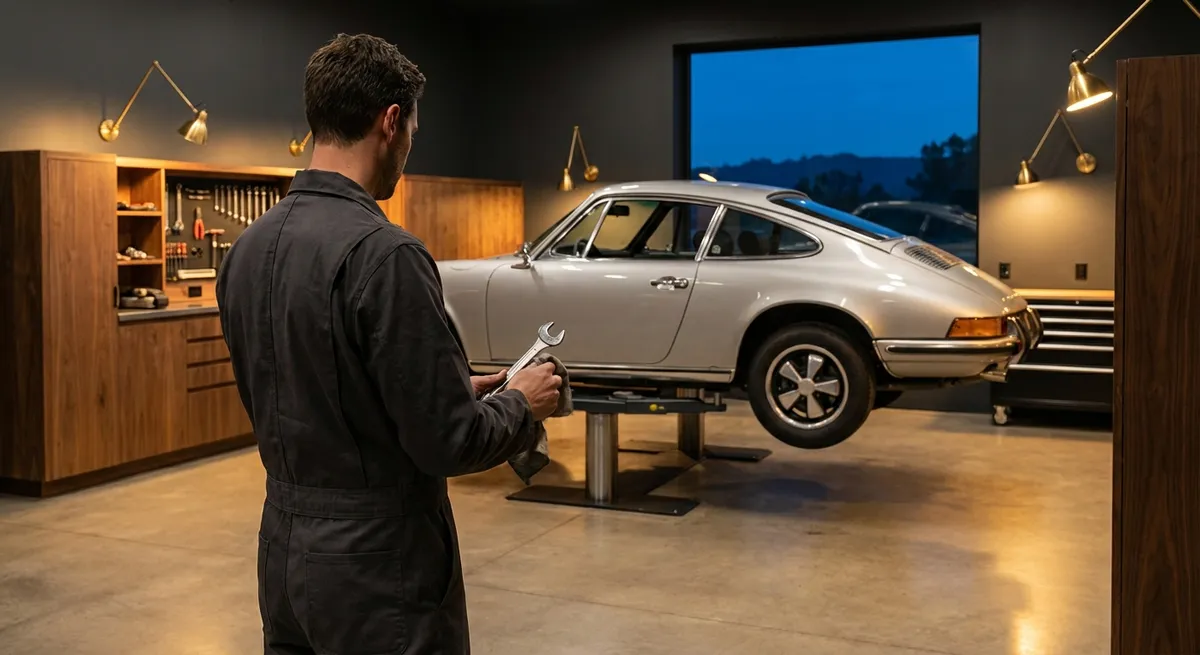
A well-appointed home does not end at the front door. For many discerning homeowners, the garage is both an arrival sequence and a discreet workhorse—a space that must function flawlessly while remaining visually composed and acoustically restrained. When something fails, the goal is not a quick patch but a repair solution that restores quiet confidence, protects investments, and respects the architectural integrity of the property. This guide explores refined, high-caliber repair approaches that align with that standard—practical, precise, and built to last.
Seeing the Garage as a System, Not a Collection of Parts
A sophisticated repair begins with a change in perspective: the garage is a system, not a series of isolated components. Treating issues in isolation—replacing a spring here, tightening a track there—often leads to recurring problems and subtle degradation in performance.
A system-focused approach considers how the door, opener, springs, tracks, seals, and structural framing interact under load, temperature changes, and daily cycles. When diagnosing a problem, a seasoned technician will examine balance, travel limits, force settings, hinge integrity, and even the alignment of the header and jambs. This reveals root causes rather than symptoms.
For homeowners, the implication is clear: when a repair is needed, ask for a full-system evaluation, not a “single-part swap.” A high-quality service call should include force testing for safety, door balance checks with the opener disconnected, visual inspection of cables and bearings, and verification that the door is properly sealed against the elements. Addressing the ecosystem instead of the single failure point yields smoother motion, lower noise, and significantly less strain on the opener—protecting both aesthetics and longevity.
Exclusive Insight 1: Precision Balancing as the Hidden Performance Upgrade
Most garages operate in a state of “almost right”—the door opens and closes, but the springs are not perfectly calibrated to the door’s weight. This imbalance often goes unnoticed because the opener compensates, silently overworking to mask the misalignment.
A precisely balanced door, when disconnected from the opener, should remain in place at multiple positions: partially open, halfway, and fully open, without drifting. If it slams shut or drifts upward, the spring tension is off. While adjusting torsion springs is not a DIY task, commissioning a professional to perform a true balancing session turns a basic repair into a performance upgrade.
The benefits are substantial: reduced load on the opener motor, quieter operation, less wear on gears and drive mechanisms, and fewer mid-cycle stalls in extreme temperatures. Premium homes often invest heavily in beautiful insulated doors; precision balancing ensures that investment doesn’t become a burden on the mechanical system. It is perhaps the most overlooked repair technique that directly enhances both refinement and reliability.
Exclusive Insight 2: Noise Mapping to Eliminate Mechanical “Signature”
Noise is often treated as an annoyance rather than a diagnostic tool. Yet every rattle, squeak, and thud is a mechanical “signature” revealing the state of the system. A sophisticated repair approach treats sound as data.
Noise mapping is a simple but highly effective process: standing at various points (inside the garage, in adjacent rooms, along the driveway) and listening carefully as the door operates. Different sounds—metallic scraping, rhythmic ticking, deep vibration—tend to correlate with specific problems: misaligned tracks, worn rollers, failing bearings, or loose hardware.
With this information, a technician can prioritize targeted interventions: upgrading from metal to nylon rollers, adding vibration isolation pads to the opener mounting, tightening lag bolts into the framing, or realigning sections to avoid panel binding. The result is not merely “quieter”—it is a refined, controlled motion that feels appropriately engineered for an upscale property. For homeowners who prize acoustic discretion, this type of repair is non-negotiable.
Exclusive Insight 3: Weather Sealing as Structural Protection, Not Cosmetic Trim
Bottom seals, side jamb seals, and top weatherstripping are often regarded as secondary details—until a storm-driven rain, a winter draft, or a pest intrusion proves otherwise. In refined homes, these seals play a more important role: they protect stored vehicles, finishes, and mechanical systems from incremental moisture and temperature damage.
A repair that includes comprehensive sealing goes beyond slapping on a new rubber strip. It evaluates:
- The compression level of the bottom seal against varying floor contours
- The flexibility and UV resistance of side and top seals
- The interaction between the threshold and door bottom, especially with heavy, insulated doors
- Potential water entry points where framing meets masonry
Attending to these details maintains stable conditions in the garage, reducing corrosion risk on vehicles, extending the life of tools and stored equipment, and preventing moisture migrations that can affect adjacent living spaces. In climates with significant temperature swings, proper sealing can also reduce energy loss from attached garages, protecting the home’s overall efficiency. A well-executed “seal repair” is less about appearance and more about safeguarding the home’s envelope.
Exclusive Insight 4: Intelligent Opener Calibration Instead of Default Settings
Many openers are installed and left at factory defaults—force, speed, and travel limits pre-set to “average” conditions. In a premium setting, “average” is rarely acceptable. Opener calibration is where subtle refinement and safety converge.
A thoughtfully calibrated opener considers:
- Door weight and insulation level
- Spring balance accuracy
- Desired acoustic profile (slower speed can mean quieter performance)
- Family usage patterns (early-morning departures, late-night arrivals, frequent cycling)
During a repair, adjusting force settings to the minimum necessary to move the door safely reduces strain and improves safety; excessive force can mask obstructions and increase the risk of damage or injury. Precisely tuning up and down travel limits prevents the door from either crushing into the floor or bouncing off the header seal.
In addition, premium operators now offer soft-start and soft-stop functions, which can be optimized during service so the door glides into position rather than slamming or jerking. Combined with an upgraded belt-drive or direct-drive unit, this transforms the door’s movement from utilitarian to almost architectural—more akin to a finely adjusted lift than a basic mechanical gate.
Exclusive Insight 5: Treating Hardware Upgrades as Long-Term Risk Management
Many repair visits end with a quick fix using the least expensive parts that meet minimum specifications. For homeowners who expect their garage to perform at the level of the rest of the residence, a different philosophy applies: each repair is an opportunity to future-proof the system.
This approach favors:
- Higher-cycle springs rated for many more open/close cycles than standard residential sets
- Sealed or shielded bearings for smoother, longer-lasting operation
- Heavy-duty hinges and brackets to better support large, insulated, or custom doors
- Corrosion-resistant hardware in coastal or humid environments
While these components may cost more upfront, they dramatically reduce the frequency of emergency failures—broken springs, misaligned panels, or seized rollers—which are the most disruptive and often occur at the least convenient times. The added benefit is consistency: the door behaves the same on a cold winter morning as it does on a hot summer afternoon, with minimal drift in performance over years of use.
When engaging a repair professional, homeowners should feel comfortable asking not just, “Can you fix this?” but “What is your most durable solution for this?” The answer reveals whether the provider is thinking in terms of minimal compliance or elevated, long-horizon reliability.
Integrating Aesthetics and Function in Every Repair Decision
In distinguished homes, the garage is increasingly visible—glass-panel doors, architectural lighting, and well-finished interiors have turned it into an extension of the living environment. Repairs that ignore aesthetics feel out of place. Repairs that respect design while enhancing performance feel intentional.
This might mean choosing low-profile hardware for contemporary doors, routing wiring discreetly rather than stapling it across visible surfaces, or color-matching replacement components where feasible. It could also include integrating smart controls that align with existing home automation systems, or repositioning safety sensors so they are effective yet unobtrusive.
The most satisfying repair solutions live where engineering and design overlap: a door that glides quietly, seals cleanly, responds reliably, and visually respects the architecture it serves. For homeowners unwilling to compromise on either form or function, insisting on this integrated standard transforms every repair from a necessary inconvenience into a subtle upgrade of the home’s overall experience.
Conclusion
A premium garage repair is not about emergency response; it is about restoring and elevating a critical system so it behaves with the calm reliability of well-considered engineering. By viewing the garage as an integrated mechanism, prioritizing precision balancing, using sound as a diagnostic tool, treating sealing as structural protection, calibrating the opener intelligently, and investing in higher-spec hardware, homeowners create an environment where the garage supports the rest of the residence with quiet authority.
These are the repair solutions that do more than get the door moving again—they protect valuables, preserve comfort, and align the most practical entry to the home with the level of refinement found everywhere else on the property.
Sources
- U.S. Consumer Product Safety Commission – Garage Door Safety - Authoritative guidance on safe operation and force settings for garage door openers
- U.S. Department of Energy – Attached Garage Efficiency - Explains how garages impact home energy performance and why sealing and insulation matter
- International Association of Certified Home Inspectors – Garage Door Systems - Technical overview of garage door components, balance testing, and inspection standards
- Clopay Garage Doors – Weatherstripping and Sealing Guide - Manufacturer-level recommendations for weather sealing and protecting the garage envelope
- LiftMaster – Safety Reversal & Force Adjustment Instructions - Detailed procedures for testing and calibrating opener force and travel for optimal performance and safety
Key Takeaway
The most important thing to remember from this article is that this information can change how you think about Repair Solutions.