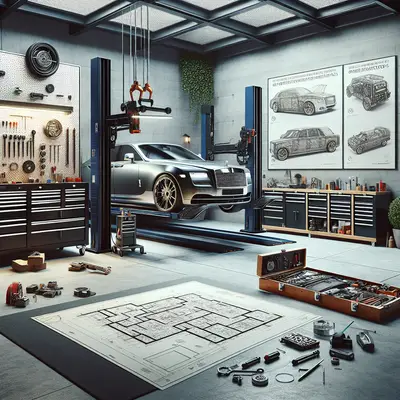
A well-designed garage should feel composed, not chaotic—especially when something breaks. Yet many homeowners experience the opposite: frantic calls to “whoever can come first,” rushed decisions, and repairs that solve the symptom but quietly incubate the next failure. This is where a more refined approach to repair makes a measurable difference. When you treat your garage not as a utility space but as a mechanical environment worth curating, every fix can become a quiet restoration of order, safety, and long-term value.
Below are five exclusive, often-overlooked insights that help transform garage repairs from disruptive emergencies into deliberate improvements that feel almost effortless in hindsight.
1. Diagnose the System, Not Just the Symptom
Most garage repairs are treated as one-off events: a broken spring, a door that won’t close, a tripped circuit, a mysterious water stain on the slab. Addressing only what is visibly wrong is convenient—but rarely complete.
A more elevated approach is to treat each issue as a signal from a larger system. For example, a garage door opener that “suddenly” stops mid-cycle may not be failing on its own. It might be compensating for:
- Door panels that are slightly warped from moisture or heat
- Rollers that no longer glide smoothly on the track
- Springs that have lost proper tension, forcing the motor to work beyond its intended load
Similarly, a patch of rust at the base of a door track is not merely cosmetic. It might indicate capillary water intrusion, insufficient drainage at the threshold, or even groundwater wicking through unsealed slab edges. Each of these has very different implications for long-term repair strategy.
An experienced repair professional will:
- Ask how long the problem has been developing, not just when it became intolerable
- Evaluate adjacent systems (tracks, seals, electrical wiring, overhead structure, drainage) even if they “seem fine”
- Provide you with a hierarchy of causes: what is urgent, what is secondary, and what can be planned for later
This diagnostic mindset doesn’t just solve the current issue; it quietly stabilizes the entire environment of your garage so that small concerns don’t accumulate into expensive structural or mechanical failures.
2. Choose Hardware That Ages Gracefully, Not Merely “Works”
Most garages rely on hardware specified to the bare minimum needed to function. That approach might be acceptable in low-use environments—but for a frequently used, vehicle-centric space, it is often a false economy.
When planning or approving repairs, focus on components that are engineered to age well:
- Higher-cycle springs: Standard torsion springs are often rated for around 10,000 cycles. In a busy household, that may be only 5–7 years. Opting for higher-cycle springs can substantially extend the interval between major repairs and reduce stress on the opener motor.
- Sealed, ball-bearing rollers: Nylon rollers with sealed ball bearings glide more quietly, reduce vibration, and protect the door tracks over time, particularly in garages integrated directly with living spaces.
- Corrosion-resistant hardware: In coastal regions or climates with heavy use of road salt, stainless or zinc-plated fasteners, hinges, and brackets can dramatically extend the functional and aesthetic lifespan of your door assembly.
The most refined solution is not the most expensive; it is the one that best aligns with your usage pattern, local climate, and long-term expectations. A discerning homeowner asks repair professionals to explain why a given part is being used and what its rated lifespan is under real-world conditions.
Well-chosen hardware doesn’t just perform; it ages in a manner that feels consistent with a home designed to be enjoyed, not constantly attended to.
3. Integrate Safety Upgrades Into Every Repair Decision
Garage repairs are often prompted by inconvenience, but the more fundamental concern is safety. A garage is a mechanical nexus for a home: stored fuel, heavy moving doors, high-torque springs, electrical circuits, and sometimes gas appliances all share the same envelope.
A sophisticated repair strategy treats every visit as an opportunity to raise the safety baseline, not just restore function:
- Auto-reverse and photo-eye testing: Whenever door or opener work is done, insist on a full safety test of the auto-reverse force and photoelectric sensors. These features are not merely conveniences; they are critical protections, especially in homes with children or pets.
- Balance and manual release: A balanced door should stay in place when disconnected from the opener and lifted halfway. If it doesn’t, it places undue stress on the motor and poses a risk if the manual release is used during an emergency power outage.
- Fire separation integrity: If your garage shares a wall or ceiling with living spaces, any repair affecting drywall, penetrations, or sealing should respect fire-rated assemblies and self-closing mechanisms on house-entry doors.
By folding these checks into repair work, your garage becomes less of a question mark during emergencies. You aren’t just fixing a malfunction—you’re affirming that core safety mechanisms are intact and thoughtfully maintained.
4. Treat Moisture and Air Intrusion as Mechanical Issues, Not Just Comfort Problems
From a premium-home perspective, temperature and humidity are not merely comfort preferences; they define how long your finishes, tools, equipment, and mechanical systems will last. Moisture and uncontrolled air movement in the garage accelerate rust, stress your HVAC system if the garage is attached, and can undermine the performance of the door itself.
When a repair technician recommends new bottom seals, perimeter weatherstripping, or threshold adjustments, it is easy to classify these as “nice-to-have” add-ons. In reality, they are mechanical guardians:
- Door seals and thresholds: Properly installed seals prevent wind-driven rain, dust, and pests from entering, protecting door tracks, sensors, and stored belongings.
- Slab cracks and minor water intrusion: Early attention to these issues, including appropriate sealants or drainage adjustments, can prevent heaving, spalling, and misalignment that will later affect how the door tracks and seals perform.
- Conditioned-space boundaries: In attached garages, air sealing at the shared wall and ceiling, along with a well-sealed entry door, helps keep vehicle fumes and unconditioned air where they belong—out of living spaces.
The refined mindset is to view every repair as a chance to tighten the building envelope in subtle, targeted ways. Over time, this approach cultivates a garage that feels drier, quieter, and mechanically more predictable—attributes that become especially noticeable during extreme seasons.
5. Establish a “Repair Dossier” to Turn Future Emergencies Into Routine Calls
One of the most exclusive advantages a homeowner can give themselves is something few ever organize: a deliberate, well-maintained record of all major garage repairs, adjustments, and components.
This “repair dossier” can be as simple as a dedicated digital folder or as refined as a printed, labeled binder kept in the garage. What matters is the detail and consistency:
Include:
- Door and opener models, serial numbers, and installation dates
- Spring type, size, and cycle rating recorded at install or replacement
- Dates of major adjustments (spring tension, track alignment, opener settings)
- Notes on environmental upgrades such as new seals, drainage corrections, or added insulation
The benefit is profound when something does fail. Instead of a frantic explanation over the phone—“It’s a door from…some time ago, from a brand I don’t remember”—your repair contact has precise information before they arrive. They can pre-select the right parts, anticipate wear issues based on age and cycles, and spend more time executing fine-tuned work and less time improvising.
For homeowners who value discretion and efficiency, this kind of record-keeping transforms an emergency from a disruptive event into a scheduled service call with predictable outcomes.
Conclusion
Elegant garage repair is not about grand gestures or flashy upgrades. It is about quiet competence: diagnosing the entire system, selecting components that age with grace, embedding safety into every decision, controlling the environment, and keeping a thoughtful record of what has been done.
When each repair is approached as an opportunity to refine rather than merely restore, the garage evolves from a background utility into a well-orchestrated mechanical space that consistently supports how you live. The result is subtle yet unmistakable: fewer surprises, less noise—both literal and figurative—and a level of reliability that feels right at home in a thoughtfully curated property.
Sources
- U.S. Consumer Product Safety Commission – Garage Door Safety Guidelines – Overview of key safety features and recommended practices for residential garage doors
- International Association of Certified Home Inspectors – Garage Inspection Standards – Detailed guidance on structural, mechanical, and safety aspects inspectors evaluate in garages
- UL Solutions – Automatic Garage Door Operator Requirements – Technical and safety standards for modern garage door openers and operators
- Energy Star – Air Sealing Your Home – Best practices for sealing building envelopes, including attached garages and conditioned boundaries
- Portland Cement Association – Control of Cracking in Concrete Structures – Technical background on concrete slab behavior, cracking, and moisture-related issues relevant to garage floors
Key Takeaway
The most important thing to remember from this article is that this information can change how you think about Repair Solutions.