The most successful garage upgrades are rarely the ones that shout. They are the quiet interventions—the systems, finishes, and refinements that dissolve into the architecture while transforming how the space feels, functions, and performs. For homeowners who expect their garage to match the standard of the rest of the residence, the goal is not spectacle; it is seamless excellence.
This guide explores refined upgrade strategies that resolve common garage frustrations—noise, drafts, clutter, harsh lighting, and flimsy finishes—without compromising the understated elegance of a well-composed home. Each insight is designed to solve a problem and then vanish into the background.
Reimagining the Garage as a Conditioned Buffer Zone
Most garages sit awkwardly between indoors and outdoors: neither fully protected nor truly exposed. Upgrading this “in‑between” zone into a controlled buffer dramatically improves comfort, energy performance, and even acoustics in adjacent rooms.
A subtle first step is air sealing—around the garage door jambs, service doors, ceiling penetrations, and the wall shared with conditioned living space. Using high-quality weatherstripping, door sweeps, and low-expansion foam around gaps reduces drafts, fumes migration, and sound transfer. Paired with upgraded insulation in the common wall and ceiling (commonly recommended to meet or exceed local energy code), the garage becomes a stable envelope rather than a thermal weak point.
For homeowners dealing with persistent fumes or humidity, a discreet, code-compliant exhaust fan on a timer or humidity sensor can quietly maintain air quality without turning the garage into a noisy mechanical room. The result is not just a more comfortable garage—it’s a calmer adjacent kitchen, family room, or bedroom, with fewer temperature swings and less intrusion from smells or noise.
Exclusive Insight #1: Treat the garage as a “performance gasket” for the home—an intentional thermal and acoustic buffer rather than a leftover space. This mindset reframes every upgrade decision, pushing you toward materials and details that support the entire home’s comfort, not just the garage’s appearance.
Precision Lighting That Flatters, Not Exposes
Most garages are overlit and underconsidered—harsh, blue-white light that’s unforgiving to finishes and uncomfortable to the eye. A premium upgrade strategy favors layered, warm, and highly controlled lighting that reveals detail without overwhelming the space.
Replacing basic screw-in bulbs with high CRI (Color Rendering Index) LED fixtures markedly improves how colors read—particularly on vehicles, cabinetry, and flooring. Aim for a color temperature around 3000K–3500K for a residential garage: warm enough to feel inviting, crisp enough for tasks. Recessed or low-profile surface-mounted fixtures keep ceilings visually clean and reduce the industrial feel.
For work zones, consider linear LED task lighting along walls or under cabinets, rather than a single overhead flood. A narrow beam, directed at the bench or storage, refines visibility without blasting the entire room. Smart dimmers or scene controls allow you to move from “arrival” lighting (soft, general) to “project” lighting (bright, focused) with a single touch.
Exclusive Insight #2: Use light to control perception of height and width. Wall washing (fixtures that graze the walls) makes a narrow garage feel more generous, while evenly spaced ceiling lights, aligned with vehicle bays, help visually “frame” each car, giving the space a gallery-like composure.
Storage That Feels Built-In, Not Bolted On
Clutter is the enemy of a refined garage. But the typical solution—exposed metal racks and plastic bins—solves the mess while undermining the aesthetic. The alternative is storage that behaves like millwork: measured, aligned, and architecturally integrated.
Custom or semi-custom garage cabinetry in muted, matte finishes (think soft grays, taupe, or deep charcoal) conceals tools, sports gear, and seasonal items behind flush, handleless doors or minimal hardware. Full-height installations, with toe kicks and finished end panels, visually extend the walls instead of reading as add-on furniture.
Ceiling storage, often a visual distraction, can be tamed by limiting it to the rear third of the garage and aligning racks with structural lines or lighting. When overhead systems are necessary near the door, choose powder-coated metal in a tone close to the ceiling color to minimize visual noise. Wall-mounted slat systems or rail systems—when carefully curated and not overfilled—offer flexible organization that can still appear intentional and ordered.
Exclusive Insight #3: Design storage elevations like you would a built-in in a living room—continuous lines, aligned door reveals, and consistent vertical divisions. Even in a utilitarian space, rhythm and proportion quietly communicate quality.
Surfaces That Endure Without Demanding Attention
The difference between a “nice” garage and an exceptional one is often underfoot. Flooring and wall finishes influence not only how the space looks, but how it sounds, wears, and cleans. Upgrading these elements can solve persistent issues—dust, staining, echoing acoustics—while maintaining an understated aesthetic.
A professionally installed, high-solids epoxy or polyaspartic floor system, with subtle flakes or a uniform satin finish, resists hot-tire pickup, oil stains, and moisture far better than bare concrete or DIY coatings. Choosing a color slightly darker than the walls (such as warm greige or slate) keeps the floor from visually dominating and tends to hide minor dirt between cleanings.
On the walls, durable, washable paint in an eggshell or matte finish offers a refined surface that can withstand scuffs and periodic washing. In garages that double as hobby or exercise spaces, adding acoustic panels disguised as framed “art” or as fabric-wrapped sections on the wall can significantly soften noise from tools, music, or workouts, without making the room look commercial.
Exclusive Insight #4: Select a floor finish that visually “bridges” the color of your vehicles and cabinetry. When the floor harmonizes with both, the eye reads the area as a continuous, composed environment rather than a series of separate elements.
Door and Hardware Upgrades That Redefine the First Impression
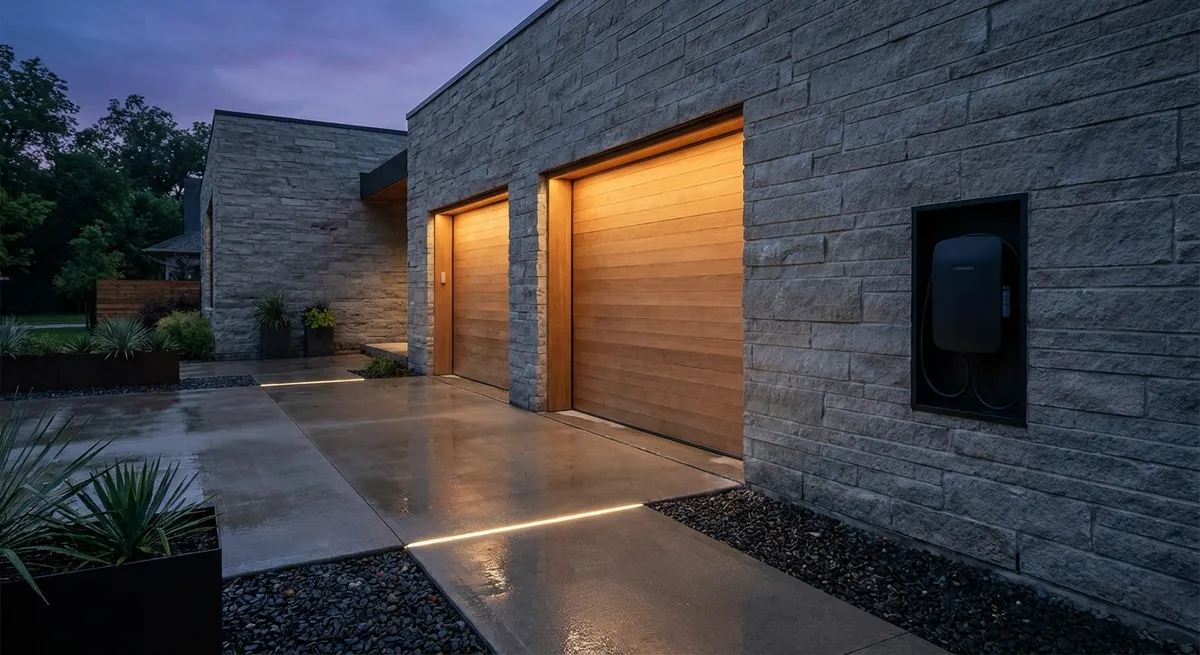
For many homes, the garage door is the largest single design element visible from the street. Yet functionally, it is also one of the most complex moving systems on the property. Upgrading both the door and its hardware can solve chronic noise, drafts, and reliability issues while dramatically elevating curb appeal.
Choosing an insulated, steel or composite door with a quiet, belt-drive or direct-drive opener instantly reduces operating noise and improves thermal performance, especially in attached garages. When paired with properly balanced torsion springs and nylon rollers, the door’s movement becomes controlled and almost theatrical—smooth, measured, and unobtrusive.
Aesthetically, refined panel profiles, restrained window patterns, and finishes that coordinate with the home’s trim or front door create cohesion without appearing ostentatious. Subtle hardware—minimalist handles, low-profile hinges, and concealed struts—helps the door read as an architectural plane rather than a mechanical object. Inside the garage, upgrading the service door to a solid-core, well-sealed unit further enhances security, fire separation, and acoustics.
Exclusive Insight #5: Think of the garage door as part of your façade composition, not an afterthought. Align panel breaks with architectural lines—siding courses, window heads, or trim bands—to make the door feel intentionally woven into the elevation rather than simply installed in an opening.
Conclusion
A truly elevated garage is not about spectacle—it is about restraint, precision, and purpose. By treating the space as an architectural asset rather than a storage annex, every upgrade becomes an investment in long-term comfort, quiet reliability, and visual harmony.
When air sealing turns the garage into a protective buffer, lighting flatters rather than exposes, storage behaves like built-in millwork, surfaces quietly withstand abuse, and doors move with almost silent authority, the garage ceases to be the “back of house.” It becomes a composed threshold to the home—one that serves demanding, everyday use while maintaining a calm, refined presence.
For homeowners who expect excellence from every square foot of their property, the garage is no longer exempt. It is simply the next frontier for discreet, intelligent upgrades that work flawlessly—and almost invisibly—every day.
Sources
- U.S. Department of Energy – Air Sealing Your Home - Guidance on reducing drafts and improving the building envelope, highly relevant to garage air sealing and comfort.
- ENERGY STAR – Insulation and Air Sealing - Explains best practices for insulation and sealing, including attached spaces like garages.
- International Association of Certified Home Inspectors – Attached Garage Fire Hazards - Details safety, separation, and door requirements between garages and living spaces.
- Occupational Safety and Health Administration (OSHA) – Garage and Shop Lighting - Offers principles of effective, safe task lighting that can be applied to residential garages.
- Cornell University – Noise and Acoustics Basics - Provides foundational understanding of room acoustics, useful for planning quieter, more refined garage environments.
Key Takeaway
The most important thing to remember from this article is that this information can change how you think about Upgrades.