A well-resolved garage does not draw attention to itself; it simply works—silently, reliably, and with a level of refinement that matches the rest of a considered home. For many owners, the garage is the least glamorous square footage on the property, yet it endures the harshest conditions and protects some of the most valuable assets. Thoughtful upgrades can transform it from a utilitarian afterthought into a precision-tuned space that operates with the calm assurance of a well‑engineered machine.
Below are five exclusive, often-overlooked insights that bring a higher standard of performance, comfort, and longevity to any garage that is ready to move beyond “good enough.”
1. Treat the Garage Door as a Moving Wall, Not a Commodity
For most homes, the largest moving element is not indoors—it is the garage door. When problems arise (noise, misalignment, uneven lifting), many owners look at the door as a disposable panel instead of what it truly is: a structural, mechanical, and thermal system.
A refined upgrade begins with the door’s core construction. Insulated steel or composite doors with a polyurethane or polystyrene core do far more than stabilize interior temperature; they dramatically reduce vibration, which is often the root cause of rattles and premature hardware wear. Reinforcing struts installed correctly along the top sections keep the door from flexing, particularly in wider openings, and this rigidity allows the opener to operate with less strain.
Premium-installed weatherstripping at the jambs and a high‑quality bottom seal introduce another layer of intelligence. These details prevent water intrusion that swells framing, corrodes tracks, and saturates stored items, while also blocking drafts and dust that travel surprisingly far into the home. Torsion springs, when properly matched to the specific door weight rather than “close enough” approximations, ensure balanced lifting, quieter operation, and a longer, more predictable service life.
Reframing the garage door as a moving wall encourages investment in balance, insulation, and sealing—not just appearance. The result is a door that feels lighter, sounds restrained, and operates with the quiet certainty of a well‑designed mechanism.
2. Upgrade the Opener to a Drive System You Can Live With
Most garage frustrations trace back to the opener: the hum, chain chatter, stuttering starts, or erratic stops. Yet when replacing an opener, many homeowners look only at horsepower and price. A more discerning approach considers drive technology, control intelligence, and how these influence both day‑to‑day use and long‑term reliability.
Belt‑drive and direct‑drive systems, especially when paired with soft‑start/soft‑stop logic, significantly reduce resonance transmitted through the structure. This is particularly valuable in homes with living space above or adjacent to the garage, where a basic chain‑drive opener can turn late‑night arrivals into a household‑wide announcement. A well‑tuned belt‑drive opener, by contrast, delivers a smooth, almost understated motion that becomes part of the home’s acoustic backdrop rather than a disruption.
Modern openers can also be calibrated far more precisely than many installers attempt. Travel limits, force sensitivity, and speed profiles can be fine‑tuned so the door moves efficiently without slamming the endpoints. Higher‑end models introduce battery backup, which transforms the garage from a liability during power outages into a dependable point of access, especially important in regions with frequent storms or for homes that rely on powered vehicles and medical equipment.
Finally, integrating smart controls is not about novelty; it is about assurance. Real‑time alerts if the door is left open, remote closing from a phone, and event logs that show when the door was operated add a layer of quiet security. When the opener is treated not as a commodity but as part of the home’s access ecosystem, it becomes an understated ally in daily life.
3. Engineer the Floor, Don’t Just Cover It
The garage floor endures what few interior surfaces ever face: hot tires, road salt, chemical spills, dropped tools, and seasonal moisture. Many upgrades focus on surface appearance—paint, inexpensive epoxy, or modular tiles—yet the most satisfying results come from engineering the floor as a system.
Preparation is the true luxury here. Professional‑grade grinding or shot‑blasting removes laitance, old coatings, and contaminants, opening the concrete so that high‑solids epoxy or polyaspartic systems can chemically bond rather than merely rest on top. Hairline cracks, control joints, and spalls are repaired with compatible fillers designed to flex and cure with the coating, preventing telegraphed lines and premature failures.
Beyond coatings, attention to slope and drainage is transformative. Subtle regrading toward a trench drain keeps meltwater, rain, and wash‑down runoff away from walls and stored belongings. This not only elevates daily usability but also protects the foundation and framing from chronic moisture exposure, a quiet threat that often goes unnoticed until damage is extensive.
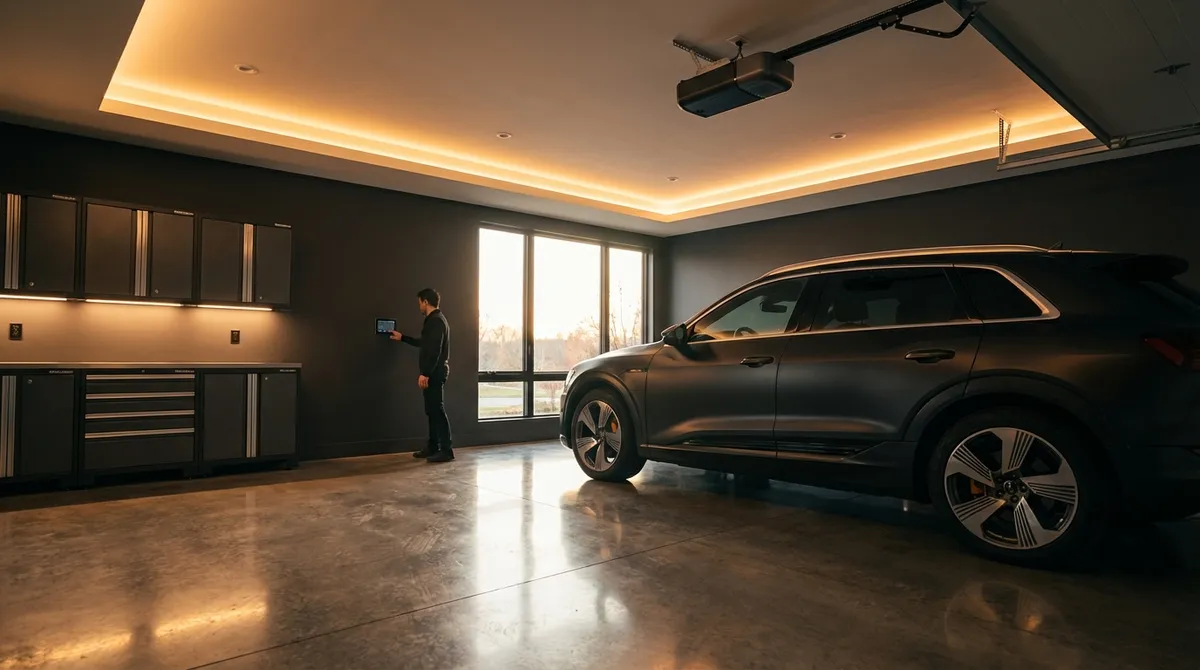
For homeowners seeking a more architectural aesthetic, polished concrete with densifier and penetrating sealer offers a sleek, low‑sheen finish that resists dusting and stains. It is a minimalist solution that pairs well with high‑end vehicles and tool storage, and it wears in gracefully rather than wearing out. Either path—premium coatings or polished systems—transforms the floor from a vulnerable slab into a designed, durable surface that respects the caliber of what is stored above it.
4. Create a Stable Microclimate for Vehicles and Storage
A garage that feels merely “unheated” in winter or “warm” in summer may seem acceptable, yet swings in humidity and temperature quietly accelerate corrosion, degrade finishes, and age plastics, rubber, and electronics stored in boxes. Upgrading the garage to a stable microclimate is less about maximum comfort and more about controlled moderation.
Efficient microclimate control begins with air‑sealing and insulation. Sealing penetrations around electrical conduits, plumbing, and the attic hatch limits infiltration, while properly installed wall and ceiling insulation slow heat transfer. When combined with the insulated door mentioned earlier, these measures allow even modest heating or cooling equipment to have outsized impact.
For many climates, the most critical upgrade is humidity control. A high‑quality dehumidifier sized for the space can maintain relative humidity in a range that discourages rust on tools and vehicles, prevents mold on stored goods, and reduces condensation on cold surfaces. In more extreme environments, a small, sealed‑combustion heater or ducted mini‑split heat pump offers a refined solution, delivering controlled temperature without introducing combustion byproducts into the space. Careful attention must be paid to code requirements for separation between conditioned garage air and the home’s living space, especially when dealing with exhaust gases and automotive storage.
The result of a well‑managed microclimate is subtle yet profound: vehicles start more willingly, finishes maintain their depth and clarity, and stored possessions emerge in the same condition they entered. The garage ceases to be an uncontrolled buffer zone and becomes a protective envelope.
5. Design the Lighting and Power Layout as if the Garage Truly Matters
Lighting and electrical service in many garages are an afterthought: a single bare bulb, a couple of outlets, and an extension cord doing work it was never meant to do. Yet the garage is often where detailed tasks occur—load‑in and load‑out, maintenance, repairs, or simple daily transitions into and out of the home.
Upgrading lighting with intention begins by establishing layered illumination. High‑CRI (Color Rendering Index) LED fixtures with a neutral white temperature offer clarity without harshness, making paint colors, fluids, and fine details easier to see. Linear LED strips or low‑glare panels installed perpendicular to vehicles reduce shadowing, while targeted task lighting above workbenches and detailing areas adds precision where it counts. Motion‑activated entry lighting near doors eliminates the fumbling that often defines late‑night arrivals.
Electrical upgrades deserve equal seriousness. Dedicated, GFCI‑protected circuits for power tools, EV charging, and air compressors prevent nuisance trips and unsafe overloading. When EV charging is part of the plan, installing properly sized circuits and receptacles (or hard‑wired EVSE) ensures efficient, safe charging today and prepares the space for future vehicle upgrades. Strategically spaced outlets at sensible heights along the walls minimize extension cord clutter and allow for flexible reconfiguration of storage and work zones.
Thoughtfully designed lighting and power transform the garage from a dim utility zone into a capable, confident workspace—one that feels aligned with the rest of a sophisticated home rather than tacked onto it.
Conclusion
Upgrading a garage is less about spectacle and more about discipline: calibrating movement, controlling climate, engineering surfaces, and respecting the details of access, power, and light. When each element is treated as part of a cohesive system, the garage evolves from a place you tolerate into a space you trust.
For homeowners who value quiet performance and durable assurance, these upgrades are not indulgences—they are long‑term refinements that protect investments, streamline daily rituals, and bring the garage up to the standards the rest of the home already enjoys.
Sources
- U.S. Department of Energy – Insulated Garage Doors – Explains benefits of insulated doors and their impact on energy use and comfort
- International Association of Certified Home Inspectors – Garage Inspections – Details common garage issues and best practices for safety and performance
- Occupational Safety and Health Administration (OSHA) – Garage and Workshop Electrical Safety – Provides guidance on safe electrical layouts and circuit protection in work areas
- National Renewable Energy Laboratory – High-Performance Residential Lighting – Offers insight into efficient, high‑quality lighting strategies applicable to garages
- U.S. Environmental Protection Agency – Moisture Control Guidance for Building Design – Covers principles of moisture and humidity management relevant to garage microclimates
Key Takeaway
The most important thing to remember from this article is that this information can change how you think about Upgrades.