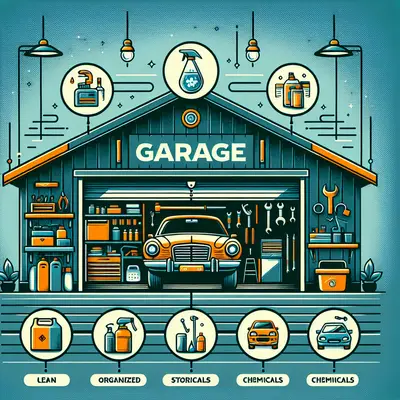
A well-kept garage is less about storage and more about standards. It is the threshold between the outside world and the calm order of your home—a space where engineering, utility, and restraint quietly intersect. Thoughtful maintenance here is not a chore; it is a disciplined ritual that preserves reliability, protects valuable equipment, and prevents the kind of failures that demand attention at precisely the wrong moment.
This guide explores a more refined approach to garage maintenance: measured, methodical, and intentionally designed. Within it are five exclusive insights that discerning homeowners rely on to keep their garages operating at a level that feels effortless—even though it is anything but.
Viewing the Garage as a System, Not a Collection of Parts
Most homeowners react to individual failures: a door that sticks, a light that flickers, a floor that stains. The more sophisticated approach is to view the entire garage as an integrated mechanical and environmental system.
The door, opener, tracks, weather seals, electrical circuits, insulation, storage, and even the floor coating work together. Each either protects or undermines the others. A compromised bottom seal, for example, doesn’t merely let in drafts; it invites moisture that can rust tools, corrode vehicles, and accelerate deterioration of door hardware.
Begin by mapping your garage as a system. Identify the following:
- Protective envelope: door seals, thresholds, side jamb seals, wall insulation, and any window weatherstripping.
- Mechanical core: door springs, opener, pulleys, tracks, hinges, and rollers.
- Environmental controls: ventilation, dehumidification, and any heating/cooling elements.
- Infrastructure: electrical circuits, GFCI outlets, lighting, and storage anchor points.
Once you see it as a system, maintenance becomes a structured cycle: you preserve the envelope to protect the mechanical core; you maintain ventilation to protect metal components; you maintain power and lighting to safely service every other element. This perspective transforms ad-hoc fixes into a deliberate, preventative routine.
Exclusive Insight 1: The Silent Baseline Check
Exceptional maintenance begins with knowing what “normal” truly feels, sounds, and looks like. Professionals build a mental baseline; homeowners rarely do. This is a subtle but powerful differentiator.
Set aside ten minutes when the house is quiet and perform what can be considered your baseline run:
- Open and close the garage door fully three times, standing at different vantage points. Listen for mechanical rhythm: a consistent, low, even sound with no grinding, popping, or rattling.
- Observe the door edges in motion. They should travel smoothly without shimmer, wobble, or visible binding in the tracks.
- Place your fingertips lightly on the door panels during operation (from inside, away from pinch points). A well-tuned door transmits steady, low vibration—not pulses, jolts, or sudden shudders.
- Turn off all lights, then activate only the opener’s built-in lighting. Any flicker or delay may indicate impending issues with the opener, bulbs, or wiring.
Document this baseline: a short video on your phone, a note about sounds or vibration levels, even the time it takes the door to open fully. Months later, subtle changes become obvious when you compare. This non-intrusive habit helps you catch emerging problems—misaligned tracks, weakening springs, or failing rollers—while the fix is still simple and controlled.
Exclusive Insight 2: Precision Lubrication, Not Casual Spraying
Most garages either suffer from neglect or from overzealous lubrication. In both cases, performance declines. True refinement comes from precision: knowing what to lubricate, with what, and how often.
Key principles:
- Use the right product: For door components, a high-quality lithium-based or synthetic garage door lubricant is ideal. Avoid generic penetrating oils as your primary lubricant; they’re excellent for freeing stuck parts but poor at long-term lubrication.
- Target the correct components:
- Hinges (pivot points only, not the entire hinge plate)
- Steel rollers (axles and ball bearings if exposed—not nylon wheel surfaces)
- Springs (a light coating to minimize corrosion, not saturation)
- Lock mechanisms and key cylinders (sparingly)
- Avoid lubricating:
- Tracks: they should be clean, dry, and free from debris, not greasy. Lubrication here attracts dust and grit, creating binding.
- Rubber weather seals: these benefit from a silicone-based conditioner, not conventional lubricants.
A refined routine might include a quarterly inspection and touch-up rather than an annual, heavy-handed spray. The goal is controlled smoothness: enough lubrication to reduce friction and noise without creating residue or streaks on adjacent surfaces. This attention to detail yields a door that moves quietly, confidently, and without the chaotic build-up that often leads to premature wear.
Exclusive Insight 3: Environmental Conditioning as Hidden Protection
Moisture and temperature swings quietly do more damage to a garage than any single mechanical fault. Yet environmental control is often overlooked in maintenance planning.
Focusing on your garage’s microclimate provides compounding benefits:
- Humidity control: In humid regions or near coasts, a small, efficient dehumidifier can be as protective as a major repair. Reduced moisture slows corrosion on springs, tracks, tools, and stored equipment, and helps maintain the integrity of electrical components and GFCI outlets.
- Strategic ventilation: Even without full HVAC, a combination of passive vents and a quiet exhaust fan can dramatically reduce condensation and fumes from vehicles, paints, and solvents. This also protects the opener’s electronics and sensor lenses from film and residue buildup.
- Floor strategy: A sealed or coated floor is not just visual refinement; it simplifies cleaning, reduces dust, and prevents moisture wicking into the slab. Less dust means fewer particulates on rollers, tracks, and photo-eye sensors.
- Smart temperature thresholds: If your garage is semi-conditioned, aim for stability, not luxury. The goal is to reduce extreme temperature swings that cause expansion and contraction of tracks, door panels, and fasteners.
By treating environmental control as a maintenance tool—not merely a comfort upgrade—you preserve the entire system. Your door moves more consistently, metal components corrode more slowly, and stored items remain in superior condition, all with minimal ongoing effort.
Exclusive Insight 4: The Fastener Audit—Invisible Source of Many “Mysterious” Noises
Creaks, rattles, and intermittent binding are often blamed on the opener, when the real culprit is simpler: fasteners that have subtly worked loose over time. A fastener audit is a hallmark of serious maintenance and is rarely performed by casual homeowners.
At least once a year, and ideally twice, methodically inspect:
- Hinge screws along all door panels
- Track mounting brackets to the wall and ceiling
- Opener mounting hardware, including angle iron supports and header brackets
- Strut and reinforcement bars on larger or heavier doors
- Anchor bolts for storage systems attached to walls or ceiling, which can transmit vibrations and noise
Use the appropriate driver or socket; avoid over-tightening, which can strip wood or metal and introduce new problems. Your aim is firm, not forced. While auditing, look for ovalized holes, hairline cracks in brackets, or rusted hardware—subtle indicators that a component is under more stress than intended.
This single practice can eliminate a surprising percentage of bothersome noises, prevent progressive misalignment, and reduce stress on the opener. It is an understated but powerful way to maintain that sense of silent, precise operation that distinguishes a well-kept garage from a merely functional one.
Exclusive Insight 5: Calibrated Safety as a Standard, Not an Afterthought
Safety features in modern garage systems are often treated as background assurances—until they fail. The refined approach is to treat them as active components requiring regular calibration and proof of performance.
Incorporate these checks into your maintenance rhythm:
- Photo-eye alignment test: Once a month, close the door using the wall control and wave a long object (such as a broom handle) through the sensor beam. The door should reverse immediately. If it doesn’t, clean the lenses, verify alignment, and re-test. Misaligned or dirty sensors are among the most common, and most easily preventable, issues.
- Reversal force test: Place a piece of scrap wood (such as a 2x4 laid flat) under the door. When closing, the door should contact the wood, stop, and reverse within seconds. Failure here demands prompt adjustment or professional service; this is a core safety function.
- Manual release verification: At least twice a year, with the door in the closed position, pull the emergency release handle. Confirm the door can be lifted manually with reasonable effort and lowered smoothly. This ensures you are not dependent solely on the opener in an outage or emergency.
- GFCI and circuit testing: Use the “test” and “reset” buttons on GFCI outlets and breakers to confirm they trip and restore correctly. This is particularly important for garages where moisture and power tools coexist.
By weaving these checks into your maintenance routine, you move beyond simple functionality into a culture of controlled safety. The garage becomes a space where every motion—mechanical or manual—feels deliberate, predictable, and considered.
Conclusion
A refined garage is rarely loud about its quality. Its excellence reveals itself in what does not happen: doors that do not jam, mechanisms that do not shriek, tools that do not rust prematurely, lights that do not flicker when most needed. This composure is the result of deliberate, well-structured maintenance—conducted not sporadically, but as a quiet, recurring ritual.
By treating the garage as an integrated system, defining a clear performance baseline, practicing precision lubrication, managing its environment, auditing its fasteners, and calibrating its safety features, you create more than a functional space. You cultivate a reliable, high-performance threshold to your home—one that reflects not only what you own, but how seriously you care for it.
Sources
- U.S. Consumer Product Safety Commission – Garage Door Safety - Background on safety concerns and the importance of reversal mechanisms and sensors
- International Association of Certified Home Inspectors – Garage Inspection Guidelines - Detailed overview of components and safety considerations in garage systems
- Clopay Garage Doors – Maintenance & Troubleshooting - Manufacturer guidance on lubrication, inspection, and routine care of residential garage doors
- U.S. Department of Energy – Air Sealing Your Home - Insight into building envelope principles and why seals, gaps, and weatherstripping matter in attached garages
- Occupational Safety and Health Administration (OSHA) – Hand and Power Tools Safety - Relevant for maintaining a safe, well-managed environment when using and storing tools in the garage
Key Takeaway
The most important thing to remember from this article is that this information can change how you think about Maintenance.