When a garage door operates well, it all but disappears from daily thought—a seamless motion, a muted close, a reassuring sense of security. Yet the moment it falters, it becomes the loudest element of the home, both literally and figuratively. For homeowners who view their property as a refined ecosystem rather than a collection of parts, the garage door deserves the same level of discernment as interior finishes, lighting, or climate control. This is not about superficial upgrades; it is about achieving quiet precision, enduring reliability, and an experience that feels considered every time the door moves.
Below are five exclusive, often overlooked insights that transform the garage door from a utilitarian afterthought into a finely tuned component of a sophisticated home.
Insight 1: Treat the Door as a Moving Wall, Not a Mechanical Afterthought
A garage door is functionally a moving exterior wall—large, heavy, and exposed to the same wind, moisture, and temperature extremes as any façade. Yet many homeowners still think of it as “just the door,” and that mindset leads to neglect.
Begin by assessing your door with the same scrutiny you would apply to windows or exterior cladding:
- Thermal performance: Insulated steel or composite doors with high R-values reduce temperature swings in the garage, stabilizing adjacent rooms and easing the load on HVAC systems. This matters acutely if you have living space above or beside the garage.
- Air sealing: Look for hardened, cracked, or misaligned bottom seals and side weatherstripping. Even the most elegant garage can feel drafty and dusty if the perimeter seal fails. Replacing these small components is comparatively inexpensive but yields outsized comfort and cleanliness benefits.
- Structural integrity: Hairline cracks in panels, rust along the bottom section, or subtle warping can all signal that the “moving wall” is losing its structural discipline. Left alone, these issues accelerate wear on tracks, rollers, and the opener.
Reframing the garage door as critical building envelope—not just hardware—shifts decisions from quick fixes to strategic, long-term solutions.
Insight 2: Silence Is Engineered, Not Accidental
A truly quiet garage door is not a happy accident; it is the result of correctly chosen components working in concert. Many homeowners respond to noise by lubricating anything that moves, or worse, ignoring the sound until something fails. A more refined approach is to treat noise as diagnostic data.
Focus on three areas:
- Drive system choice: Chain drives are durable but inherently louder. Belt-drive openers—especially when paired with DC motors—deliver a smoother, more composed motion profile. For attached garages, this difference is immediately perceptible in bedrooms and living spaces.
- Roller and hinge quality: Standard steel rollers can rumble and clatter as they age. Upgrading to nylon rollers with ball bearings and ensuring hinges are properly aligned dramatically reduces vibration noise. It is a modest investment with a disproportionately elegant outcome.
- Vibration isolation: Many homeowners never consider how the opener is mounted. Rubber isolation pads or vibration-dampening hangers between the opener and the ceiling structure can keep mechanical hum from telegraphing into the rest of the home.
Instead of living with groans and rattles, use them as signals: a squeal may point to dry bearings, a popping sound can indicate misaligned tracks, and a grinding tone may betray a failing opener gear. The objective is not just silence for its own sake, but silence as evidence of a properly engineered system.
Insight 3: Precision Balance Extends Life More Than Any “Heavy-Duty” Label
“Heavy-duty” springs, “premium” openers, “reinforced” tracks—all of these are meaningless if the door itself is not precisely balanced. A well-balanced door, when disconnected from the opener, should sit comfortably at various positions (about halfway, three-quarters, and fully open) without drifting up or slamming down. This is not merely a performance nicety; it is an essential safety and longevity factor.
When balance is off, consider what happens:
- The opener works harder on every cycle, reducing its lifespan and increasing the risk of mid-life failure.
- Cables, drums, and brackets absorb excessive strain, which can manifest as frayed cables, bent hardware, or, in serious cases, sudden component failure.
- The door’s path may subtly skew, putting uneven pressure on the tracks and leading to premature wear or derailment.
Balancing torsion or extension springs is not a homeowner task—it requires specialized tools and carries real risk. Yet scheduling professional balancing every few years (or immediately after any panel replacement, insulation upgrade, or door weight change) is one of the most intelligent, underutilized ways to protect the system. Many homeowners upgrade openers repeatedly, when the true problem was a misbalanced door quietly stressing the mechanism.
Insight 4: Intelligent Controls Are Not a Gadget—They’re an Insurance Policy
Modern garage door controls have evolved beyond simple remote buttons into an ecosystem that, when used thoughtfully, blends convenience with genuine risk reduction. For homeowners with high-value vehicles, tools, or home access via the garage, this is not a luxury—it is a strategic safeguard.
Look beyond basic “smart opener” marketing and seek features with real-world value:
- Real-time status and alerts: Knowing whether the door is open or closed from your phone—and receiving alerts when it remains open longer than a chosen interval—prevents accidental all-night vulnerabilities.
- Activity logs: Timestamped records of openings and closings allow you to detect patterns and anomalies, such as repeated activation at unusual hours.
- Geofencing and scheduled closures: Automated closing at set times, or closing triggered when all residents have left a defined area, mitigates human forgetfulness without adding daily friction.
- Secure access sharing: Temporary or PIN-based access for service providers or guests eliminates the need to disclose permanent codes.
When integrated with home security systems, these controls form a more sophisticated perimeter strategy: the garage becomes a monitored point of entry with defined rules, rather than a loosely managed back door.
Insight 5: Moisture, Light, and Air Reveal the Next Failure Before It Happens
Most garage door failures are telegraphed months in advance—but the signals are rarely where homeowners are looking. Instead of fixating solely on the door and opener, pay attention to the environment they inhabit.
Three subtle diagnostics can be revealing:
- Moisture patterns on the floor: Repeated dampness near the door line, even with the door closed, signals compromised seals, misaligned concrete, or slight door warping. Over time, this invites corrosion in tracks, bottom brackets, and fasteners—the quiet start of structural fatigue.
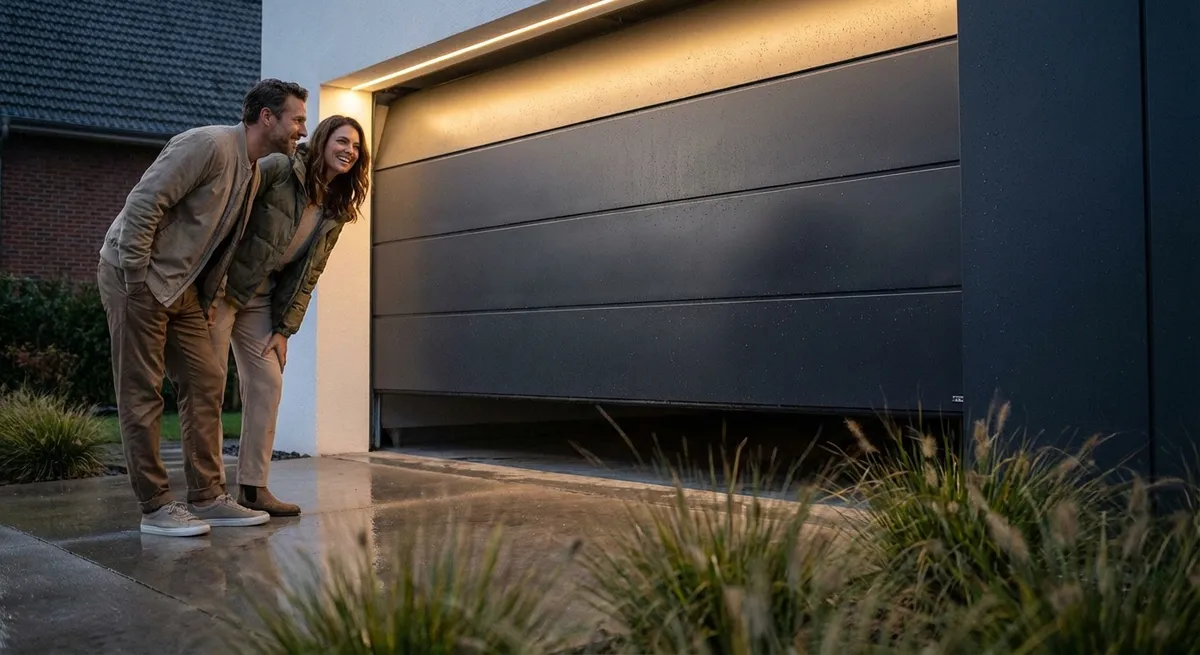
- Daylight leakage: A quick check from inside the garage during daylight hours is surprisingly telling. Light streaming in along the sides or bottom of the door indicates not just air leakage, but potential alignment or framing shifts. This may require adjusting tracks, replacing seals, or, in older garages, addressing settling or structural movement.
- Condensation and temperature swings: If you notice condensation on the interior of the door or wild temperature fluctuations inside the garage, it may point to inadequate insulation or compromised weather barriers. This does more than inconvenience you—it stresses metal springs and hardware subjected to sharp thermal cycling and can degrade opener electronics over time.
By reading these environmental cues, homeowners can intervene elegantly and early, commissioning targeted adjustments rather than waiting for a dramatic hardware failure. It is a mindset of continuous, light-touch refinement instead of reactive emergency repair.
Conclusion
A garage door can either be the noisiest compromise in an otherwise refined home or a quietly confident piece of engineering that disappears into your daily rhythm. The distinction lies in how you think about it: as a moving wall, not just a mechanical device; as a system where silence, balance, and control are designed, not improvised; as an environment where light, moisture, and air reveal issues long before they become emergencies.
For homeowners who value composure, reliability, and thoughtful detail, investing attention in the garage door is not a niche obsession. It is a logical extension of caring about how every element of the home performs—every time it moves, closes, and protects what matters inside.
Sources
- U.S. Department of Energy – Insulated Garage Doors – Explains how insulated doors affect home comfort and energy performance
- International Door Association (IDA) – Homeowner Garage Door Safety – Covers best practices for safe operation, balance, and professional maintenance
- Consumer Product Safety Commission – Garage Door and Opener Safety – Details safety considerations and common hazards related to garage doors and openers
- Cornell University – Building Envelope and Air Sealing Basics – Provides foundational insight into air sealing, relevant to understanding weatherstripping and energy loss
- Chamberlain Group – MyQ Smart Garage Technology Overview – Describes modern smart garage control features, remote monitoring, and security capabilities
Key Takeaway
The most important thing to remember from this article is that this information can change how you think about Garage Doors.