Most homeowners think of the garage as storage on the side of the house. In reality, it’s one of the most critical pieces of residential infrastructure you own: it carries loads, manages temperature swings, protects valuable equipment, and acts as a first line of security. When it’s upgraded with intention, the entire property feels more composed, quieter, and markedly more refined.
This guide explores garage upgrades not as surface-level makeovers, but as structural, mechanical, and functional enhancements that future‑proof your home. Within that lens, you’ll find five exclusive insights that discerning homeowners often discover only after costly mistakes—or after working with high-end builders and consultants.
Rethinking the Garage as a “Mechanical Room” for Daily Life
Most garages are treated as oversize closets. The more sophisticated approach is to treat the garage as a mechanical hub: a transitional space where climate, security, power, and storage are deliberately orchestrated.
The first step is assessing how your garage is actually used. Is it a staging area for sports gear and luggage, a workshop, a vehicle gallery, or a delivery and package zone? Each use pattern has different implications for lighting, outlets, storage heights, flooring durability, and ventilation. A garage that serves as a “mechanical room” for daily life requires dedicated circuits for tools or EV charging, high‑CRI LED task lighting (for color accuracy and reduced eye strain), and materials selected for cleanability rather than simply appearance. The result is not a showroom, but a space where every routine—arriving home late, unloading groceries, cycling before dawn—feels frictionless and intentionally supported by the environment.
In practical terms, this may mean rethinking the ceiling as valuable real estate for suspended storage and lighting runs, mapping traffic paths before installing cabinets, and planning power locations based on where chargers, compressors, and benches will live. When you treat the garage as a working system instead of a leftover room, upgrade decisions suddenly become clearer and far more effective.
Insight 1: Structural and Moisture Control Upgrades Are the True Luxury
High‑gloss floors and sleek cabinetry are tempting, but the most “luxurious” garage upgrade is invisible: a structure that resists moisture, movement, and temperature extremes. This is what keeps everything else performing—and what protects the investments parked or stored inside.
Begin with the floor and walls. If your slab shows hairline cracks, efflorescence (white powder), or areas that stay dark after rain, you may have moisture vapor transmission issues. Before any coating or tile goes down, consider a moisture test and, where needed, a vapor barrier coating or repair solutions recommended by a structural or concrete specialist. Ignoring this step is why many attractive floor systems peel, bubble, or discolor within a few seasons.
Similarly, look at your wall assemblies. Are exterior walls insulated? Is there a continuous air barrier between the garage and the conditioned part of the house? Upgrading to closed‑cell spray foam or properly installed rigid insulation with sealed seams can dramatically stabilize temperatures and reduce condensation risk, which in turn protects tools, stored fabrics, and even vehicle electronics. It also improves indoor air quality by better isolating car exhaust, solvents, and dust from the living areas.
Finally, pay attention to drainage and slab slope. Water should move out of the garage—not drift back toward interior thresholds. Subtle adjustments to thresholds, trench drains, or even targeted slab grinding can have an outsized impact on longevity and day‑to‑day cleanliness, especially in climates with snow, coastal humidity, or heavy rain.
Insight 2: Precision Power and Lighting Planning Transforms Everyday Use
Most garages rely on a single overhead light and a couple of generic outlets. That’s a missed opportunity. Thoughtful electrical and lighting upgrades create a sense of ease and quiet competence every time you open the door.
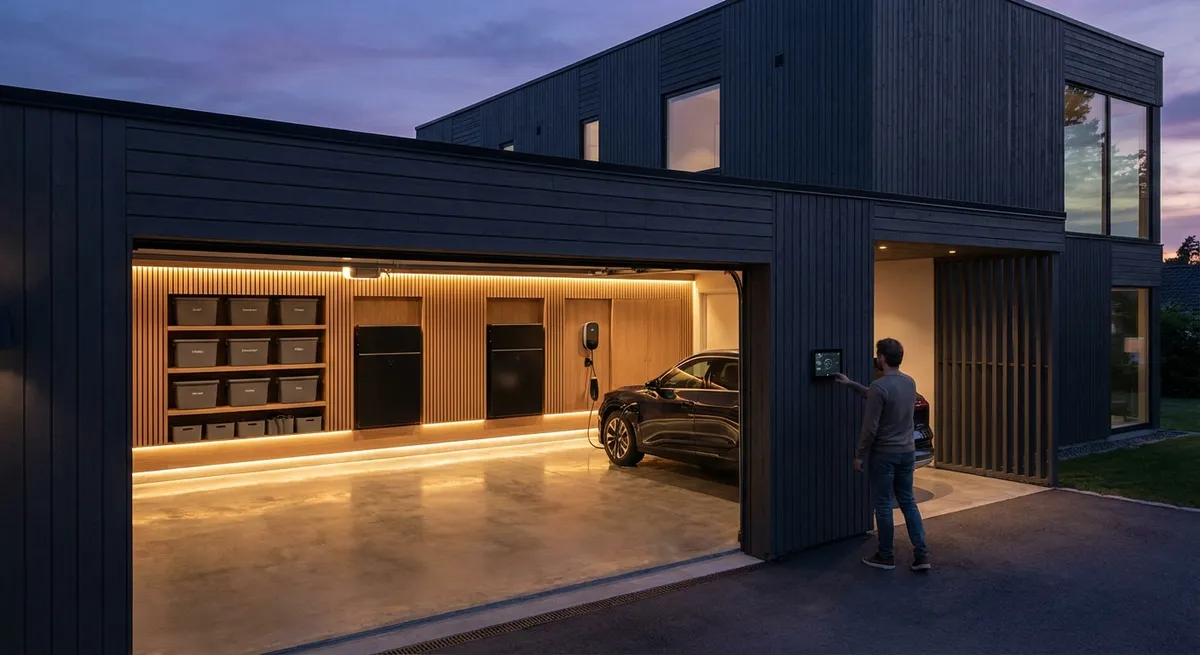
Start with circuits. If you own (or plan to own) an electric vehicle, a dedicated 240‑volt circuit with the correct amperage for your charger is non‑negotiable. Even without an EV, dedicated circuits for compressors, welders, or large power tools prevent nuisance breaker trips and ensure stable power delivery. Placement matters as much as capacity: wall-mounted outlets at bench height (not floor level) reflect a workshop mindset and reduce cord clutter.
On lighting, consider layering. Ambient lighting should be uniform and flicker‑free—typically achieved with high‑quality LED fixtures spaced to minimize shadows. Above work surfaces, narrower‑beam task lighting ensures you can read fine markings and inspect finishes without eye strain. For drivers who arrive home after dark, low‑glare perimeter lighting along walls or cabinetry edges can guide parking without harsh brightness. Choosing high‑CRI (color rendering index) lighting—90+ where possible—means paint, stains, and materials appear true to color, which is especially important for anyone who details cars or undertakes fine repair work.
Integrating motion sensors and smart switches is a subtle but meaningful enhancement. A carefully tuned delay (not the default “on/off instantly”) offers the feeling of a space that anticipates your movements instead of constantly demanding your attention.
Insight 3: Intelligent Zoning Balances Vehicles, Storage, and Workspaces
One of the most common garage frustrations is conflict between functions: bicycles tangle with vehicles, sports gear migrates into workbenches, and seasonal storage encroaches on door clearances. Solving this is less about buying more storage and more about zoning with architectural discipline.
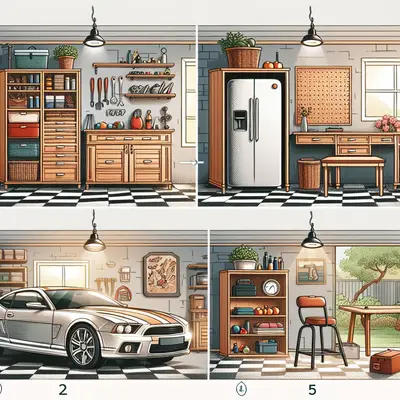
Visualize the garage in “bands” or zones. The vehicle zone should be sacrosanct—clear of low obstacles, cords, and protruding cabinetry that can catch doors or bumpers. Next to it, a vertical storage zone along side walls can be optimized with rail systems, slatwall, or custom shelving that keeps objects within defined height ranges: heavy items between knee and waist height, frequently used items within easy reach, and long-term storage higher up but still secure.
Toward the back or one side, designate a proper work zone. This area benefits from softer flooring underfoot (such as interlocking tiles or cushioned mats), more concentrated task lighting, and outlets every few feet along the bench. If noise and dust are concerns, consider partial partitions or ceiling-hung curtains that can be drawn to contain debris and reduce clutter spillover.
Even overhead space can be zoned. Ceiling racks above the vehicle zone should be shallow and carefully measured to avoid any interference with garage door tracks or openers. Deeper racks are better placed over non‑vehicle zones. A sophisticated layout often emerges from tape and chalk on the floor before any permanent installation—mocking up clearances, door swings, and walking paths to ensure the space works under real-world conditions, not just on paper.
Insight 4: Quiet, Sealed, and Secure—The New Standard for Openers and Doors
Upgrading the garage door and opener is about far more than aesthetics; it directly affects noise levels, energy performance, and security. For a refined home, a loud chain‑drive opener and a rattling, uninsulated door are simply out of place.
Belt‑drive or direct‑drive openers are significantly quieter and smoother, especially when paired with a well‑balanced, properly lubricated door. When selecting a new opener, look for soft‑start and soft‑stop functions, battery backup, and robust encryption for smart connectivity. A premium system will feel almost theatrical in its restraint: the door glides instead of jerks, the motor hum is minimal, and operation is predictable even during power outages.
On the door itself, insulated steel or composite doors with high‑quality weatherstripping help stabilize garage temperatures, protect stored items, and reduce drafts into the rest of the house. Pay attention to the bottom seal and side jamb seals; these are small, inexpensive components that dramatically influence dust, water, and pest intrusion.
Security should match the rest of your property’s standards. Rolling‑code remotes, strong manual locks, and tamper‑resistant hardware reduce vulnerability. For homeowners seeking additional peace of mind, a discreet interior camera focused on the overhead door and entry door provides reliable verification without turning the space into a surveillance theater. The goal is a quiet, controlled envelope, not a fortress.
Insight 5: Ventilation, Air Quality, and Material Choices Protect What You Store
Refined garages are not simply tidy—they protect what’s stored inside, from fine tools to collector vehicles and heirloom furniture. That protection begins with the air you cannot see.
If your garage regularly hosts idling engines, solvent use, or woodworking, mechanical ventilation is essential. A modest, code‑compliant exhaust fan on a timer or occupancy sensor can clear fumes and fine particulates far more effectively than a partially open door. In humid climates, a dehumidifier sized to the space can prevent rust, mold on cardboard boxes, and deterioration of leather or fabrics.
Material selection reinforces this protective mindset. Low‑VOC paints, sealants, and adhesives reduce off‑gassing—especially critical in attached garages where air can migrate into living areas. Flooring systems that resist petroleum staining and are easy to squeegee clean invite regular maintenance instead of avoidance. Cabinetry constructed from moisture‑resistant substrates with sealed edges will outlast basic particleboard dramatically, especially when temperature swings are significant.
For homes that store sensitive items—wine fridges, audio equipment, archival boxes, or high‑end car finishes—a modest investment in monitoring pays dividends. Digital hygrometers and thermometers, placed discreetly, allow you to track conditions and adjust ventilation or dehumidification before problems appear. This is the difference between a garage that passively “stores things” and one that actively preserves them.
Conclusion
Viewed through a more sophisticated lens, garage upgrades are not about spectacle; they are about infrastructure, precision, and quiet reliability. When you prioritize structural and moisture control, design power and lighting as intentionally as any kitchen, zone the space to respect each function, refine the door and opener as part of your home’s envelope, and take air quality seriously, the garage stops feeling like the forgotten edge of the property.
Instead, it becomes an extension of the home’s overall standard—a place where vehicles, tools, and daily routines are treated with the same care you’d expect in any finely considered interior. The transformation may not shout, but you will feel it every time the door opens, the lights respond, and the space simply works.
Sources
- U.S. Department of Energy – Insulation and Air Sealing – Guidance on insulation types and their impact on comfort, moisture, and efficiency
- Energy Star – Residential Ventilation – Best practices for indoor air quality, exhaust fans, and healthy ventilation strategies
- Consumer Reports – Buying Guide: Garage Doors – Independent advice on door materials, insulation, and performance considerations
- UL Solutions – Electric Vehicle Supply Equipment Safety – Safety and technical considerations for EV charging installations in garages
- U.S. Environmental Protection Agency – Indoor Air Quality Basics – Overview of pollutants and strategies to improve air quality in attached spaces
Key Takeaway
The most important thing to remember from this article is that this information can change how you think about Upgrades.