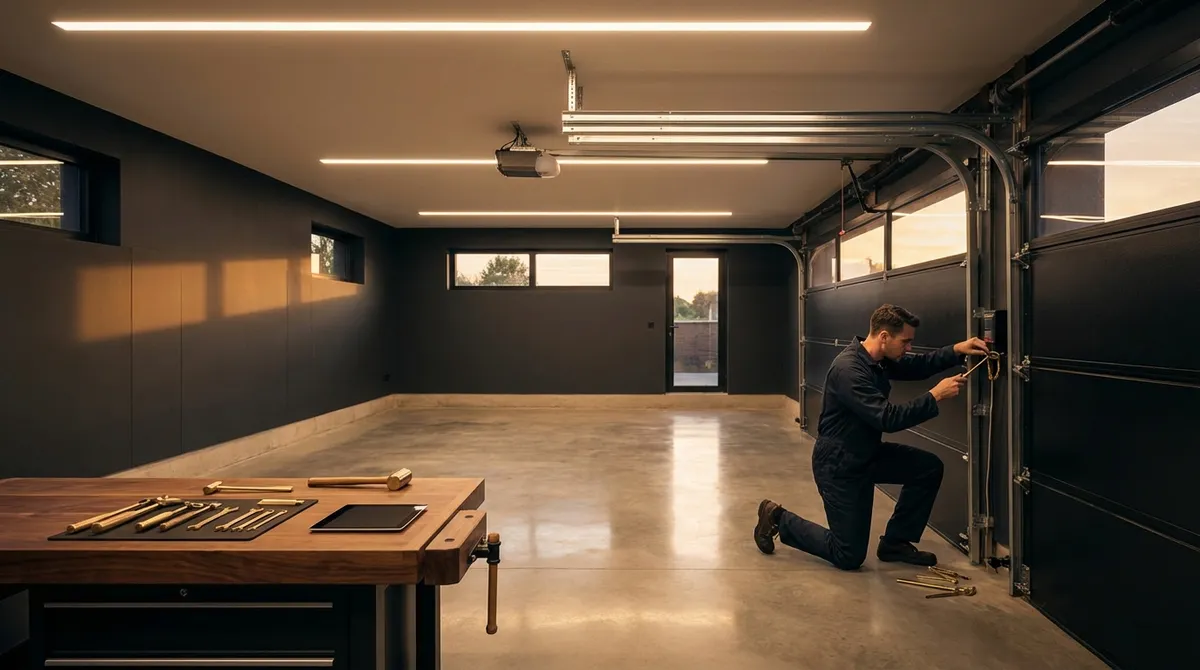
When a garage door hesitates, shudders, or refuses to close cleanly, it rarely feels like a small inconvenience. For a refined home, the garage is a piece of infrastructure as important as the front entry: it guards vehicles, safeguards storage, and shapes daily arrivals and departures. Yet most repairs are approached as urgent patchwork—done quickly, rarely done thoughtfully. This is where discerning homeowners can quietly differentiate their properties: by insisting on repair solutions that are precise, enduring, and architecturally respectful.
Below are five exclusive insights that shift garage repair from “problem solving” to “system refinement”—the level of attention a sophisticated home deserves.
1. Treat the Garage Door as a Precision System, Not a Single Component
Most repair calls are framed around the visible symptom: a broken spring, a frayed cable, a bent panel, or a misaligned safety sensor. But a truly elevated repair begins by acknowledging the garage door as a balanced mechanical system, where each element carries a specific load and failure pattern.
A premium repair experience starts with a measured assessment: door weight, spring size and cycle rating, track condition, roller type, hinge integrity, opener horsepower, and even ceiling structure. An underpowered opener pushing a heavy, poorly balanced door is not a minor mismatch—it’s a design flaw that accelerates wear, adds noise, and undermines safety. Instead of simply replacing what’s broken, the technician should recalibrate the entire system: matching torsion springs to door weight, upgrading to sealed-bearing rollers, verifying track plumb and level, and ensuring the opener is operating well within its designed torque range.
This holistic approach doesn’t just restore operation; it restores harmony. A correctly balanced door can be lifted by hand with minimal effort, moves in a single fluid motion, and allows the opener to work quietly and comfortably, not at the edge of its capability. The result is less strain, fewer emergency calls, and a daily interaction that feels intentionally engineered, not merely functional.
2. Demand Quiet Performance as a Design Standard, Not a Luxury
Noise is often dismissed as a mild annoyance, something one tolerates because “it’s just the garage.” In a well-appointed home, that mindset is misplaced. The sound profile of your garage door is an extension of your architectural experience—especially if the garage is beneath or beside living spaces or a primary bedroom.
Superior repair solutions factor in acoustics at every step. Chain-drive openers can be replaced with belt-drive or direct-drive units engineered for low vibration. Metal rollers can be upgraded to nylon, paired with properly aligned tracks and balanced springs to reduce friction and rumble. Vibration isolation pads can be placed under opener mounting brackets, lowering resonant noise transmitted into joists and finished spaces above.
Even smaller gestures matter: properly lubed hinges and springs with the correct, manufacturer-approved lubricant (never random household oils), fasteners torqued to spec to prevent panel rattling, and track bracing revised to eliminate metallic ringing. When executed thoughtfully, the door’s movement becomes a subdued, controlled motion rather than a broadcast event. Over time, this level of quiet refinement often becomes something you notice only by its absence in other homes.
3. Use Repairs as an Opportunity to Upgrade Safety and Redundancy
Many homeowners assume that if the door opens and closes, safety is “covered.” In reality, safety technologies and standards evolve, and garages frequently lag behind. A sophisticated repair strategy views each service visit as an opportunity to discreetly elevate protection—without compromising visual restraint.
This begins with basics: verifying and recalibrating photoelectric safety sensors to the correct height and alignment, testing automatic reverse force settings, and confirming the opener has compliant safety features if it is older. If a unit pre-dates modern safety requirements or uses outdated drive systems, a technician should present options for replacement as a considered upgrade, not a hard sell.
Beyond the opener, cabling and hardware deserve equal scrutiny. High-tension components like lift cables should be examined for corrosion or fraying and replaced with high-quality, properly rated cables if needed. Where practical, technicians can introduce secondary retention features—like safety containment for torsion springs or upgraded cable drums that better control the door under abnormal loads. In flood- or wind-prone regions, hardware and bracing may need to be selected not only for smooth movement, but also to comply with updated building standards and local codes.
The goal is simple: to transform each repair into an audit and correction of hidden vulnerabilities, so your garage becomes less improvisation and more engineered certainty.
4. Calibrate for Climate and Environment, Not Just Immediate Function
Most repairs stop the moment the door moves again. Elevated solutions look further ahead: how will this system behave in your actual environment over the next decade?
In cold climates, metal contracts, lubricants can thicken, and panels may warp subtly. The choice of lubricant, spring rating, and weatherstripping composition becomes central, not incidental. A thoughtful repair includes verifying bottom seal flexibility in low temperatures, ensuring side and top seals compress gently but completely, and confirming that opener force settings respect both safety and seasonal variation.
In coastal or humid environments, corrosion resistance becomes a quiet priority. Fasteners, hinges, and cables benefit from galvanized or stainless options when appropriate. Technicians should consider whether tracks and hardware are adequately treated for moisture exposure, especially in garages that see frequent wet vehicles or snow melt.
Thermal considerations also matter. If the garage door sits between conditioned interior spaces and the exterior, even a non-insulated door deserves careful sealing. Upgrading weatherstripping, applying threshold seals, and ensuring the door fully seats against the floor all contribute to comfort, energy efficiency, and a more controlled microclimate—preserving both vehicles and stored items. Climate-aware repairs are the difference between a door that simply opens and one that behaves predictably, year after year.
5. Insist on Transparent Documentation and Long-Horizon Thinking
What distinguishes a serviceable repair from an exceptional one often has little to do with tools and everything to do with documentation and planning. A premium approach treats your garage as a maintainable asset—with a recorded history, not a series of disconnected emergencies.
At the conclusion of any significant repair, you should receive more than an invoice. A refined service record includes: part specifications (spring size and cycle rating, opener model and serial, roller and hinge type), installation date, test readings (balance check, safety reversal tests), and recommended future touchpoints (for example, spring and hardware inspections every 12–18 months). These details transform future work from guesswork into precision.
This documentation also helps homeowners make better decisions. Knowing the expected lifespan of major components allows you to distinguish between parts that merit high-end upgrades and those where standard options suffice. It clarifies when a full opener replacement is more rational than serial repairs, or when incrementally upgrading hardware could be timed with other home projects.
Over time, this long-horizon thinking turns the garage from a recurring nuisance into a quietly reliable system, aligned with the standards you reserve for the rest of your home: measured, deliberate, and fully under control.
Conclusion
A garage door repair can be handled as a rushed accommodation—or as an opportunity to refine one of the most mechanically complex systems in your home. By treating the door as a precision assembly, prioritizing quiet performance, turning each repair into a safety and climate audit, and insisting on rigorous documentation, you elevate a routine service into a discreet form of property stewardship.
For homeowners who expect their spaces to operate as elegantly as they appear, this is the standard that makes sense: not merely a door that works today, but a system that performs with quiet assurance, season after season.
Sources
- U.S. Consumer Product Safety Commission – Garage Door Safety - Outlines key safety features, entrapment protection, and homeowner responsibilities for garage door systems
- International Association of Certified Home Inspectors – Garage Door Safety - Provides detailed guidance on inspection points, balance testing, safety sensors, and common failure modes
- Cornell University – Basics of Lubrication - Explains how different lubricants behave under temperature and load, relevant to springs, rollers, and hinges
- U.S. Department of Energy – Garage Energy Efficiency - Discusses how attached garages affect home comfort, heat transfer, and weatherstripping considerations
- Federal Emergency Management Agency (FEMA) – Garage Doors and Wind Performance - Covers the importance of properly rated doors and hardware in high-wind and coastal regions
Key Takeaway
The most important thing to remember from this article is that this information can change how you think about Repair Solutions.