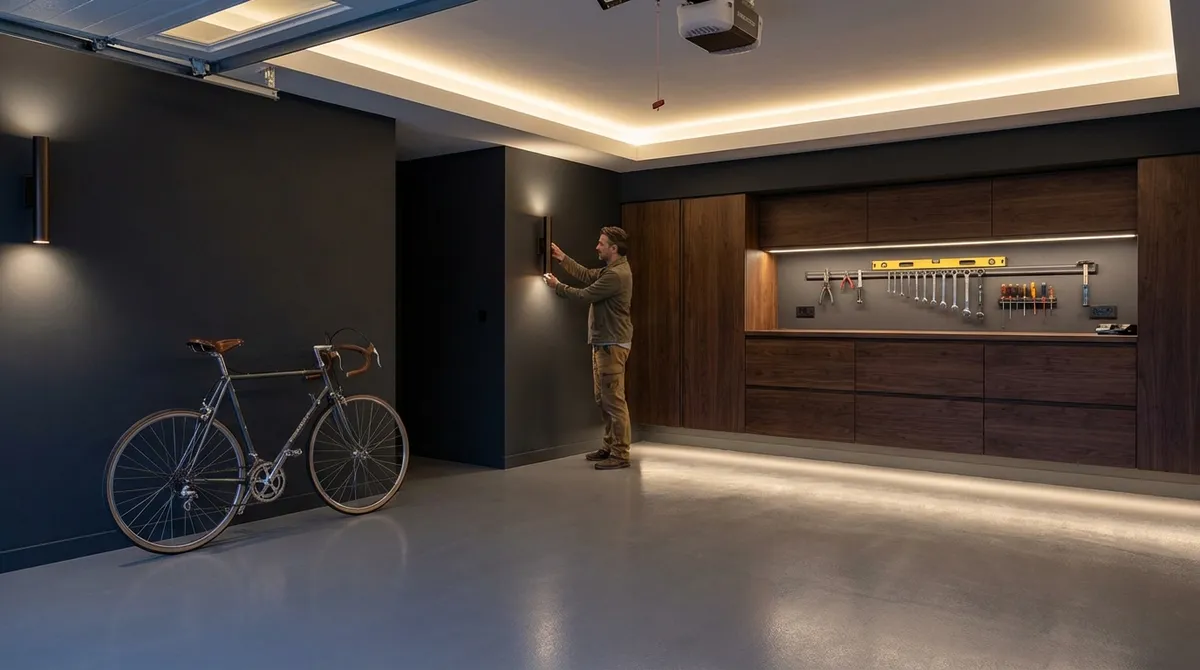
Your garage is more than a holding space for vehicles and cardboard boxes; it is a transitional room between public and private life, where security, convenience, and craftsmanship either quietly excel or quietly fail. An elevated garage doesn’t need to shout. It simply works flawlessly, looks composed, and feels like an intentional part of the home—not an afterthought tacked onto the driveway.
For homeowners who appreciate refined detail and discreet luxury, the most rewarding upgrades aren’t always the most obvious. They’re the ones you notice at 6 a.m. on a winter morning, when the door glides open without complaint, the lighting doesn’t glare, and every surface feels considered. Below are five exclusive, high‑impact insights designed for homeowners who demand more from the most overlooked room in the house.
1. Precision Balancing: The “Invisible” Upgrade That Changes Everything
Most garage upgrades start with surfaces—paint, hardware, trim—but the foundation of a truly premium experience is mechanical balance. When a garage door is properly balanced, it moves with a quiet, even grace: no jerks, no stutters, no strain on the opener. Think of it as the equivalent of a well‑tailored suit; the quality isn’t in the label, it’s in the way it moves with you. Technicians achieve this by calibrating torsion springs, fine‑tuning cable tension, and aligning track geometry to millimetric standards, not “good enough” approximations.
For the homeowner, the difference is striking. Motor noise is reduced, components wear more slowly, and the door can even be lifted manually with minimal effort in a power outage. A well‑balanced door places less stress on the opener, extending its service life and preserving that “new door” feel years longer. While balancing is rarely visible to guests, you’ll sense its presence every time you press the remote. It is the quiet, invisible upgrade that transforms daily operation into something almost effortless.
2. Layered Quiet: Acoustic Comfort for Driveway and Living Spaces
Sound is one of the most overlooked dimensions of garage comfort. A typical door rattles, hums, and vibrates through the structure, sending noise into adjacent rooms and above‑garage bedrooms. A premium upgrade strategy treats the garage as an acoustic environment, not just a storage bay. This begins with insulated door panels that soften both street noise and operational sound, paired with nylon rollers that glide instead of clatter along the track.
Next, consider an ultra‑quiet belt‑drive opener with a soft‑start and soft‑stop profile, designed to ramp speed up and down rather than jolting the system. Between the opener and the ceiling joists, vibration‑isolating mounts act like shock absorbers, preventing structural resonance. Even small touches—such as rubber grommets at mounting points and properly tensioned chains or belts—contribute to a more hushed running tone. The result is a garage that opens and closes without announcing itself to the entire house, preserving the calm of late nights and early mornings.
3. Refined Control: Intelligent Access Without the Tech Clutter
High‑end garages no longer rely on a handful of bulky remotes tossed into a console. A well‑considered access system blends discretion, security, and simplicity, without drowning the homeowner in apps and passwords. The core upgrade is a smart opener with encrypted communication—this prevents signal interception and unauthorized cloning of your code. From there, the most elegant solutions are the ones you hardly notice: a discreet keypad with soft backlighting, short‑range phone access, and quiet integration with your home’s existing ecosystem.
For discerning homeowners, the difference lies in control granularity. Temporary digital keys for guests or service providers can be scheduled to expire automatically, and notifications can confirm that the door is actually closed when you’re already at the airport. Geo‑fenced automation can open the door as you approach without broadcasting your routines to the world. When installed thoughtfully and configured properly, intelligent access doesn’t feel like a gadget; it feels like a natural extension of how you already live—tighter security, less friction, no visual clutter.
4. Climate‑Savvy Sealing: Comfort, Protection, and Subtle Efficiency
A garage that breathes uncontrolled air is harder on everything it holds—vehicles, tools, finishes, and even the interior comfort of adjacent spaces. Upgrading the perimeter sealing is one of the most underrated ways to elevate the room’s feel. Begin at the threshold: a premium bottom seal that actually conforms to subtle floor irregularities, paired with a robust threshold strip, forms a clean barrier against drafts, dust, insects, and surface water intrusion.
Side and top weatherstripping should be treated as design details, not just functional rubber. Modern profiles are available in discreet, refined finishes that complement the door and trim while closing microscopic gaps that leak conditioned air. In climates with temperature extremes, insulated doors paired with upgraded seals can protect paints, finishes, and stored goods from thermal shock. The experiential difference is immediate: fewer cold drafts, less musty odor, and a garage that feels like a controlled environment rather than an exposed annex.
5. Hardware as Jewelry: Curated Details that Age Gracefully
On a premium garage, hardware is not an afterthought—it’s the jewelry of the façade and the tactile point of contact you use every day. Cheap, mismatched hinges and handles will rust, squeak, and visually date the door long before the panels fail. Upgrading to architecturally coherent hardware is less about decoration and more about consistency and longevity. Think stainless or high‑grade powder‑coated steel components that resist corrosion, maintain their finish, and move with subtle, solid intent.
Inside the garage, attention to hardware shows up in reinforced brackets, heavy‑duty hinges, and properly spec’d tracks matched to the door’s weight and usage pattern. When these elements are right, the door feels reassuringly solid rather than fragile. Outside, handles, faux strap hinges, and accent pieces should align with the home’s architectural language—contemporary minimal, understated traditional, or something in between—so the door reads as part of the design, not pasted onto it. These curated details won’t scream for attention, but they create a cohesive, high‑end impression every time the door comes into view.
Conclusion
A sophisticated garage doesn’t rely on spectacle; it relies on systems that work perfectly, details that hold up under daily use, and upgrades that quietly improve how you live. By focusing on precision balancing, acoustic refinement, intelligent access, climate‑savvy sealing, and curated hardware, you transform the garage from a point of compromise into a point of pride.
For homeowners who value exceptional solutions over quick fixes, these upgrades turn an ordinary threshold into a finely tuned extension of the home—one that meets you every day with quiet reliability and understated luxury.
Key Takeaway
The most important thing to remember from this article is that this information can change how you think about Upgrades.