The most successful garage upgrades rarely announce themselves. They do not scream for attention; they simply make every arrival more composed, every departure more efficient, and every repair more precise. When approached with intention, the garage shifts from an overlooked utility zone to a disciplined, high‑performing extension of the home—one that feels considered rather than improvised. This is the territory where craftsmanship, quiet technology, and long‑term resilience intersect.
Below are five exclusive, detail‑driven insights for homeowners who are ready to treat the garage not as a storage afterthought, but as a finely tuned environment worthy of the rest of the residence.
Reframing the Garage as a Performance Environment
Most garages are treated as static spaces: park, store, close the door. A refined upgrade strategy begins by viewing the garage as a performance environment with three critical roles—mechanical, climatic, and organizational.
Mechanically, the garage hosts systems in motion: doors, openers, tracks, lifts, compressors, and vehicles. Any upgrade should reduce friction—literal and figurative—through smoother mechanisms, cleaner cable routing, and reduced vibration. Climatically, this is a transition chamber between exterior and interior. Floor finishes, seals, and insulation quietly manage temperature, moisture, and dust migration into the home. Organizationally, wall and ceiling systems should guide where tools, seasonal items, and equipment live, so that nothing disrupts the flow of vehicles, people, or repairs. Once you treat the garage as a performance space instead of a storage shed, your upgrade decisions become sharper, more selective, and noticeably more effective.
Insight 1: Precision Lighting for Mechanical Work—Not Just Brightness
Most garage “upgrades” stop at brighter bulbs. A premium approach aims for controlled, layered illumination calibrated to mechanical tasks. This isn’t about flooding the entire space in harsh white light; it’s about placing the right light where your hands, tools, and eyes actually work.
Begin with high‑CRI (Color Rendering Index) LED fixtures (90+ CRI) over the primary work zone so wire colors, fluid levels, and small components appear accurate and easy to distinguish. Add focused, low‑glare lighting above the hood line of a parked vehicle, reducing shadows on engine bays and wheel wells. Under‑cabinet LED strips over work surfaces prevent you from relying on a single overhead source. Finally, integrate motion‑activated secondary lighting near entry doors and the path to the house. The result is a garage that feels less like a warehouse and more like a modestly scaled workshop—calm, deliberate, and ready for meticulous repair work at any hour.
Insight 2: Floor Systems That Work as a Technical Surface, Not Just a Finish
A properly upgraded garage floor is more than a cosmetic resurface; it functions as a technical surface that supports both vehicle maintenance and long‑term durability. The objective is not a showroom gloss that hides flaws, but a resilient, predictable platform that stays clean, safe, and structurally stable.
High‑quality epoxy or polyaspartic coatings, when installed over a correctly prepared slab (mechanically ground, moisture tested, and repaired), create a surface that resists automotive fluids, road salts, and abrasion from jacks and tools. Subtle texture or non‑slip aggregates maintain footing without feeling rough or industrial. If you prefer modular tiles, prioritize load rating, chemical resistance, and edge stability instead of color patterns alone. Well‑designed floor systems also facilitate drainage and cleaning—gentle slope toward a drain or door, no low spots that harbor water or oil. In practice, this means easier leak detection, quicker cleanup after projects, and a floor that contributes to safety rather than becoming another variable to manage.
Insight 3: Smart Controls That Protect Equipment, Not Just Impress Guests
Smart garage technology is often marketed as convenience theater: app‑controlled doors, push notifications, remote viewing. A more considered upgrade strategy focuses on smart controls as guardians of your equipment, energy use, and security—quietly working in the background.
A modern, Wi‑Fi–enabled opener can log door activity, helping you identify doors left open or unusual access patterns. Integrating the opener with your home network allows for scheduled auto‑close windows at night, which is particularly valuable for garages housing tools, bikes, or high‑value equipment. Smart plugs or sub‑panel monitoring can track the energy draw of compressors, heaters, and EV chargers, revealing inefficiencies or unexpected behavior. Door and window sensors that integrate with your security system turn the garage into a monitored threshold rather than a blind spot. The purpose is not to fill your phone with alerts, but to create a quiet, data‑informed layer of protection around your mechanical and storage assets.
Insight 4: Micro‑Zoning for Temperature and Moisture Control
Treating the garage as a single homogeneous climate zone is a common mistake. A refined upgrade strategy recognizes micro‑zones—with different temperature and moisture requirements—for vehicles, tools, stored materials, and the interface to the interior of the home.
The vehicle zone benefits from sealing at the perimeter—door sweeps, weatherstripping, and threshold seals—to reduce dust and water blow‑in. Tool and equipment zones (especially those storing power tools, adhesives, paints, and lubricants) require more stable temperature and humidity to extend product life and prevent corrosion. For this, consider a modest, high‑efficiency mini‑split or controlled ventilation paired with a dehumidifier, rather than leaving the garage at the mercy of outdoor swings. The wall shared with the house deserves upgraded insulation and air sealing to keep exhaust, fumes, and temperature fluctuations from encroaching into living spaces. With thoughtful micro‑zoning, your garage becomes more than a buffer—it becomes a managed environment that preserves both tools and the adjacent interior.
Insight 5: Purpose‑Built Storage that Respects the Mechanics of Movement
Most storage upgrades fail not because of capacity, but because they ignore how people and vehicles move. The refined objective is not to line every wall with cabinets; it is to choreograph traffic so that nothing interrupts the arc of a swinging door, the opening of a hood, or the path of a rolling jack.
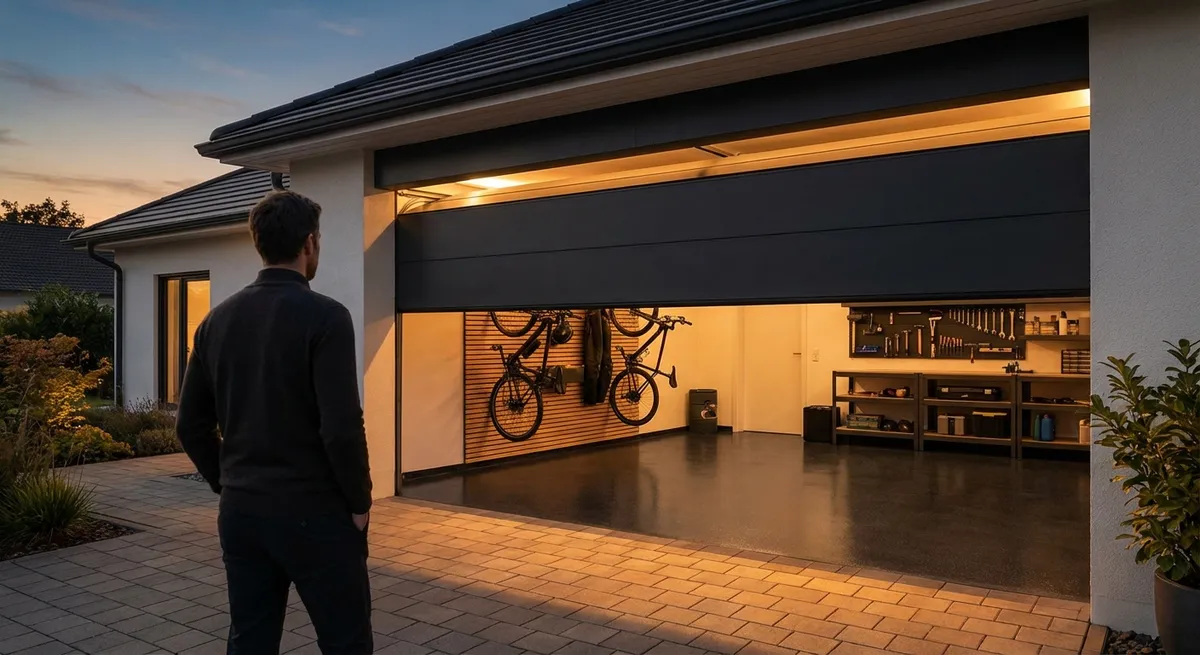
Wall‑mounted systems that keep the floor clear—French cleats, rail systems, or heavy‑duty tracks—allow you to reposition hooks, shelves, and bins as your tools and hobbies evolve. Deep cabinets should be reserved for infrequently accessed items; frequently used tools deserve shallow, easily visible storage where nothing gets buried. Overhead racks must be placed outside the vehicle door swing and well clear of garage door tracks, with load ratings appropriate to what you actually store—not their marketing maximum. The highest expression of storage in a garage is not abundance but clarity: you can lay your hands on what you need without shifting boxes, moving bicycles, or re‑parking a car.
Conclusion
A garage upgrade, at its most sophisticated, is not a parade of gadgets or a burst of decorative finishes. It is the quiet realignment of a space toward precision, safety, and ease—where lighting respects your work, floor systems support real mechanical tasks, smart controls protect your equipment, micro‑climates preserve both tools and structure, and storage patterns honor how the space is actually used.
In such a garage, repairs feel less like improvisations and more like deliberate exercises in control. Vehicles arrive and depart without conflict. Tools are where you expect them. Surfaces perform as intended. And the entire space—often the first and last room you encounter each day—operates with the understated confidence of a well‑engineered system.
Sources
- U.S. Department of Energy – Energy Efficient Garage Spaces - Guidance on insulation, air sealing, and energy performance for garages and adjacent spaces
- Electric Lighting Quality – U.S. General Services Administration - Technical overview of lighting quality, color rendering, and task illumination principles
- Concrete Network – Garage Floor Coatings - In‑depth discussion of epoxy and related floor systems, prep standards, and performance considerations
- UL Solutions – Smart Home Systems Safety Considerations - Safety and reliability insights for connected devices, relevant to smart garage controls
- EPA – Moisture Control Guidance for Building Design, Construction and Maintenance - Authoritative information on moisture management and its impact on building durability and indoor environments
Key Takeaway
The most important thing to remember from this article is that this information can change how you think about Upgrades.