The most memorable home improvements are rarely the loudest. In the garage, especially, true refinement reveals itself in quiet precision, restrained design, and systems that simply work—every time. For homeowners who expect their garage to function as seamlessly as the rest of their residence, upgrades are no longer about novelty; they are about coherence, longevity, and a certain understated elegance in daily use.
This guide explores a curated set of garage upgrades designed not for spectacle, but for those who notice—and value—the details. Each insight addresses common garage issues with solutions that are engineered, not improvised, and that elevate the space from “service area” to “integrated extension of the home.”
1. Structural Calm: Rebalancing the Door, Not Just Repairing It
Most garage interventions begin where they should: with the door. Yet many repairs address symptoms—noise, strain, misalignment—without correcting the underlying imbalance of the system.
A well‑executed upgrade begins with a full structural assessment: spring calibration, track alignment, panel integrity, and hardware uniformity. Properly balanced doors open with minimal force, glide rather than jerk, and place far less stress on the opener. The result is a perceptible quietness and a slower rate of component fatigue.
Precision spring tuning, for example, can correct the subtle pull that causes doors to bind or track unevenly, the very issue that leads to premature opener failure. Upgrading to high‑cycle torsion springs, sealed bearing rollers, and reinforced struts on larger doors not only resolves recurrent issues, but creates the reassuring sense that the system is working within its design limits—not beyond them.
For homeowners accustomed to refined mechanical experiences elsewhere in the home, this recalibration turns a formerly temperamental entry into a predictable, almost weightless motion. It is a foundational upgrade: invisible to most, indispensable to those who notice.
2. Silent Authority: Drive Systems Chosen for the Home, Not the Hardware
Too often, garage door openers are selected by horsepower and price alone. In a premium home, that’s the wrong metric. The true measure is harmony: how well the drive system integrates with the architecture, neighboring rooms, and expected patterns of use.
Direct‑drive and belt‑drive systems offer a level of acoustic discretion that chain drives cannot match. The distinction matters profoundly for garages beneath bedrooms, adjacent to living spaces, or integrated into townhomes. A carefully chosen opener, paired with vibration‑dampening mounts and balanced hardware, reduces not only sound but structural resonance—the low‑frequency rumble that travels through framing and floors.
Smart controls, when chosen judiciously, add a layer of composed convenience rather than gadget clutter. Wall‑mounted openers with integrated deadbolt‑style locking, soft‑start and soft‑stop functions, and battery backup bring a sense of authority to the system: it feels deliberate, not improvised. The door moves with intention, then settles with a quiet finality rather than a clatter.
This is an upgrade less about “adding features” and more about curating the experience of entry: silent, confident, and remarkably consistent, morning after morning.
3. Climate Discipline: Stabilizing a Volatile Space
Garages are often the most volatile environments in the home—swinging from cold to hot, dry to humid. This instability silently shortens the life of stored items, vehicles, finishes, and even the door itself. A sophisticated upgrade strategy treats the garage as a conditioned envelope, not an afterthought.
Advanced weatherstripping at the perimeter, upgraded bottom seals, and insulated door panels provide the first line of defense. But real transformation comes from strategic climate management: modest, properly sized ventilation to remove exhaust and humidity; dehumidification capable of maintaining a stable relative humidity; and, where appropriate, a low‑profile mini‑split or radiant heat source for temperate control.
These interventions protect more than comfort. Stable temperatures and humidity reduce warping in wooden doors, slow corrosion of tools and vehicles, and prevent condensation that can damage concrete and electrical components. For garages used as workshops, gyms, or detailing bays, the difference in air quality and tactile comfort is unmistakable.
A climate‑disciplined garage reads less as “utility annex” and more as “controlled environment”—a space where mechanical systems, high‑value storage, and daily traffic can coexist without conflict.
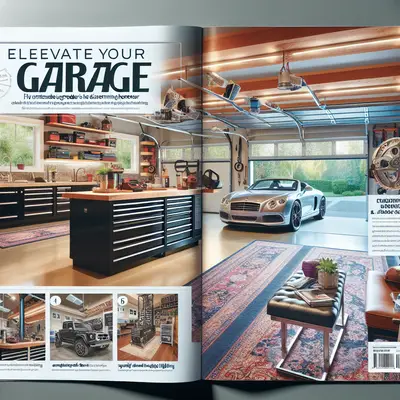
4. Visual Order as Function: Storage Designed Like Millwork, Not Racking
Traditional garage storage often looks like what it is: add‑on racking, open shelving, and improvised hooks. For homes defined by architectural restraint, this visual noise undermines the entire experience of the space. An evolved approach treats garage storage as a design element, with the same level of intention as a butler’s pantry or dressing room.
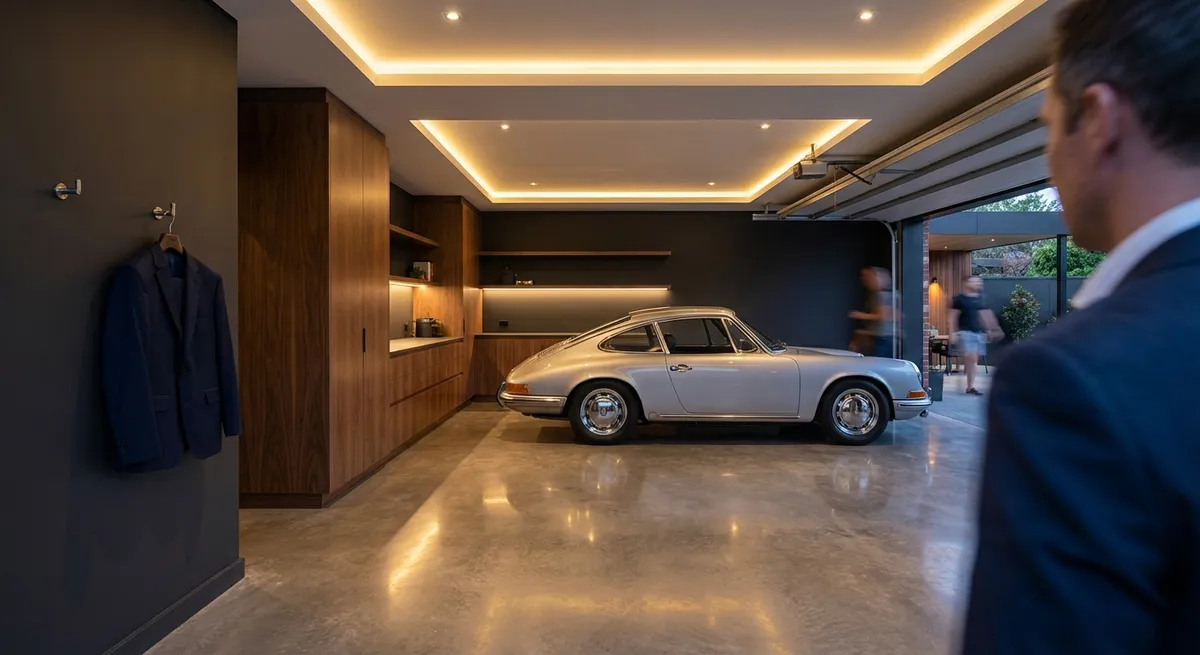
Full‑height cabinetry that conceals tools, seasonal items, and supplies creates an immediate sense of calm. The best solutions are tailored to the garage’s geometry and the homeowner’s patterns: tall, ventilated cabinets for outdoor equipment; shallow sections for chemicals and small hardware; integrated work surfaces with hidden power for tools and chargers. Finishes that coordinate with the home’s interior palette—muted lacquers, textured laminates, or understated metals—transform the garage from “back of house” to “secondary foyer.”
Importantly, this is not purely aesthetic. Concealed storage protects items from dust, sunlight, and humidity, and prevents the clutter that often interferes with safe door operation or vehicle clearance. Thoughtful zoning—clean storage near the entry to the home, more rugged storage closer to the garage door—creates a natural flow that makes daily use efficient and quietly dignified.
For homeowners who value order, this upgrade recasts the garage as a curated environment, where everything has a place and nothing distracts.
5. Electrical Foresight: Power Planned for the Next Decade, Not the Last
The most forward‑thinking garage upgrades are not always visible today; they are the ones that prevent limitations later. Nowhere is this more evident than in electrical planning.
Modern garages increasingly serve as hubs for EV charging, battery backup systems, power tools, refrigeration, and connectivity. An elegant upgrade strategy anticipates this demand: dedicated high‑amperage circuits for present or future EV chargers, isolated circuits for freezers or refrigerators, and carefully mapped outlets for tools, compressors, or gym equipment. Clean, labeled panel work; tamper‑resistant outlets; and appropriate GFCI/AFCI protection not only meet code but enhance safety and reliability.
Integrating lighting into this plan is equally critical. A layered scheme—high‑CRI overhead LED panels for general illumination, task lighting over work zones, and subtle step or perimeter lighting for safe nighttime entry—elevates the environment while using remarkably little energy. The garage becomes legible at a glance, without harsh glare or untreated shadows.
Run with intention, the electrical backbone of the garage supports both function and future flexibility. The result is a space that feels composed today and remains adaptable as vehicles, tools, and technology evolve.
Conclusion
An elevated garage is not defined by conspicuous luxury, but by the absence of friction. Doors that move with quiet assurance, storage that recedes into calm order, air that feels stable and clean, systems that simply respond—these are the hallmarks of a garage that respects the rest of the home.
By approaching upgrades as a coordinated transformation rather than isolated fixes, homeowners can resolve persistent garage frustrations while creating a space that feels aligned with their expectations elsewhere: precise, composed, and enduring. The garage ceases to be an exception; it becomes, instead, one of the home’s most quietly satisfying spaces.
Sources
- U.S. Department of Energy – Insulation & Air Sealing in Garages – Guidance on garage insulation, air sealing, and energy‑efficient detailing
- International Association of Certified Home Inspectors – Garage Inspection Guidelines – Technical insight into common garage safety, door, and structural issues
- Occupational Safety and Health Administration (OSHA) – Garage Ventilation & Air Quality Considerations – Best practices for managing fumes and ventilation in automotive and garage spaces
- U.S. Department of Energy – Electric Vehicle Charging at Home – Authoritative overview of residential EV charging requirements and electrical planning
- Consumer Product Safety Commission – Garage Door Safety and Maintenance – Detailed information on garage door safety features, balancing, and maintenance practices
Key Takeaway
The most important thing to remember from this article is that this information can change how you think about Upgrades.