A truly considered home does not end at the threshold to the garage. For discerning owners, this space is neither a storage afterthought nor a purely utilitarian annex; it is a working infrastructure zone whose refinement directly influences comfort, safety, and long-term property value. Thoughtful garage upgrades do not shout for attention—they remove friction from daily routines, suppress noise, and anticipate future needs with quiet precision.
This guide explores a calibrated approach to garage upgrades, focusing on details that matter to homeowners who expect reliability, discretion, and longevity. Below are five exclusive insights that often go unmentioned in conventional advice, but that make a tangible difference when your standards are higher than “good enough.”
Reframing the Upgrade: Treat the Garage as a Mechanical Suite
Most garages are designed as oversized closets; the refined home treats them more like a mechanical suite—where structural, electrical, and mechanical systems converge.
Instead of beginning with finishes, start by mapping the garage’s critical functions: vehicle access, power distribution, storage, work surface, climate, and security. This mindset shift has two advantages. First, it ensures upgrades serve systems, not just aesthetics. Second, it helps you identify where a modest investment—such as rebalancing the garage door, upgrading the opener, or rationalizing the circuit layout—can prevent high‑cost failures later.
Owners who manage significant assets often insist on system redundancy elsewhere in the home. The garage merits the same lens: surge protection for the opener and EV charger, dedicated circuits for high‑draw tools, and structured cabling for cameras or access control. When the garage is treated as a mechanical suite, upgrades naturally align with reliability and resilience rather than impulse enhancements.
Insight 1: Precision Door Tuning Before Any “Upgrade”
Many homeowners leap to new hardware or a premium opener when the real issue is mechanical imbalance. A misaligned or poorly tuned door is not simply an annoyance—it increases wear on every component, including the opener motor, tracks, rollers, and hinges.
A refined approach begins with a professional door balance and hardware audit:
- Spring calibration: Properly tensioned torsion or extension springs allow the door to remain in place at mid‑height without drifting. This single adjustment dramatically reduces opener strain.
- Track trueing and bracing: Slightly racked tracks or loose fasteners create vibration and noise that no “quiet” opener can fully disguise.
- Roller and hinge upgrade: Switching to nylon‑coated rollers with sealed bearings, paired with appropriately rated quiet hinges, often eliminates the harsh metallic resonance that characterizes many garages.
Only after this mechanical baseline is corrected should you consider a new opener. In many cases, owners discover that their existing motor, once relieved of undue load, becomes acceptably quiet and predictable—freeing budget for higher‑value upgrades such as surge protection or smart access integration.
Insight 2: Layered Acoustic and Thermal Control, Not Just Insulation
Garage “insulation” is often reduced to a checkbox: insulated door installed, box ticked. For a premium result—especially in homes with living spaces above or adjacent to the garage—a layered strategy is more effective than simply increasing R‑value.
Consider a three‑tier approach:
- Envelope integrity: Address air gaps first—weatherstripping at the door jambs, quality bottom seal, and proper sealing of penetrations (conduit, plumbing, and cable runs). Uncontrolled air paths undermine any insulation strategy.
- Targeted sound management: If bedrooms or a home office sit above the garage, adding a dense layer such as acoustic drywall or resilient channels under the ceiling can significantly reduce impact and motor noise. Upgraded door hardware (quiet rollers, decoupled opener mounts) complements this.
- Smart thermal zoning: Rather than installing a full HVAC system, consider a more restrained solution such as a variable‑speed, high‑efficiency mini‑split or radiant panel approach, sized solely for comfort during usage periods. Paired with a smart thermostat or occupancy sensor, the garage becomes usable year‑round without excessive energy waste.
This layered method respects the reality that a garage is not a primary living room—yet expects it to meet a higher standard than a bare concrete box open to the elements.
Insight 3: Power and Data Infrastructure That Anticipates Future Demands
EV chargers, high‑torque tools, and robust camera systems are no longer fringe luxuries. For many homes, they are either present or imminent. Upgrading the garage without a power and data strategy is akin to furnishing a room without outlets.
A future‑ready garage typically includes:
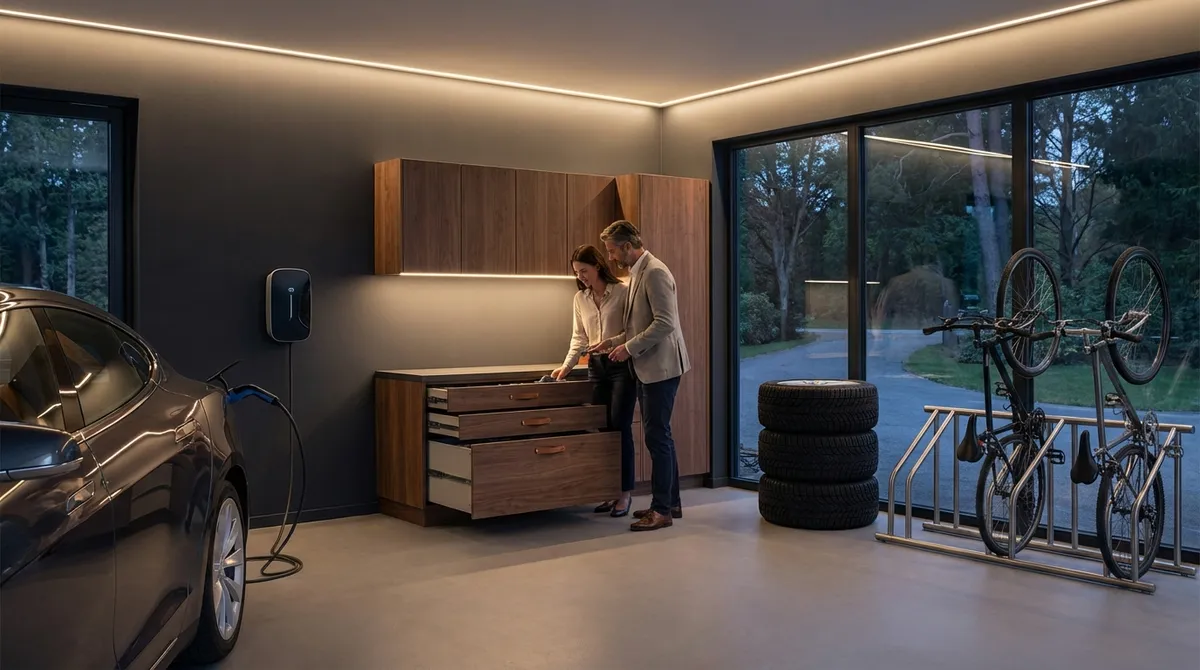
- Dedicated EV and high‑load circuits: Even if you are not yet installing an EV charger, running conduit and reserving breaker capacity now avoids invasive work later. Aim for a 240V circuit with appropriate amperage for your likely future vehicle class.
- Structured low‑voltage runs: Pre‑routing Ethernet or high‑quality low‑voltage cabling to camera locations, access points, and potential smart‑panel zones is inexpensive now and transformative later. Wireless is convenient; wired remains the gold standard for reliability.
- Panel capacity and labeling discipline: A cleanly labeled sub‑panel in or near the garage, with reserved slots and clear identification, is not merely tidy—it shortens troubleshooting time, reduces error risk, and simplifies any future upgrades.
When your garage infrastructure reflects the same planning standard as your networking closet or AV room, you avoid a patchwork of exposed cords, overtaxed outlets, and ad‑hoc installations that age poorly.
Insight 4: Storage and Surface Choices That Age Gracefully, Not Just Look New
Refined garages distinguish themselves not by how they look on day one, but by how gracefully they age after a decade of real use. This comes down to materials, load calculations, and subtle design decisions.
Elevated storage systems, for example, should be engineered not only for static load but also for vibration and dynamic load when doors open and close. Wall‑mounted cabinets anchored into studs or a dedicated wall panel system outperform freestanding units that migrate and warp over time.
On the floor, the premium choice is rarely the trendiest coating—it is the system that bonds correctly to your specific slab condition:
- Surface preparation: Moisture testing, crack repair, and mechanical grinding matter more than the brand name of the coating.
- Chemical resistance: If you store solvents, oils, or use the garage for light mechanical work, prioritize industrial‑grade epoxy or polyaspartic systems rated for chemical exposure, rather than purely decorative options.
- Maintainability: A slightly satin or matte finish often hides minor wear better than high‑gloss, while still looking intentional. Combine with a rational cleaning plan (soft squeegee, neutral detergent) and the floor remains composed, not tired.
Storage and surfaces that maintain their composure under real use contribute quietly but significantly to the sense of order every time the door opens.
Insight 5: Discreet Intelligence—Smart, But Never Fussy
Smart garage technology can either refine your daily routine or add digital clutter. The distinction lies in choosing devices and integrations that simplify, not complicate.
For access control, prioritize:
- Native integration over app proliferation: A smart opener or controller that integrates with your existing home ecosystem (Apple Home, Google Home, Alexa, or a professionally managed control system) is preferable to yet another standalone app.
- Event‑based automation: Instead of gimmicky automations, focus on those that protect and inform—automatic closing at night if left open, notifications only for unusual activity, and temporary digital keys for vendors or guests.
- Quiet fallback: Ensure that manual operation remains straightforward during power outages or network interruptions. Sophisticated does not mean fragile.
Cameras, sensors, and smart lighting follow the same principle: use them to illuminate risk points (side door, rear access, driveway) and guide safe movement, not to turn the garage into a blinking showroom. Intelligent upgrades should disappear into the background of your routine, surfacing only when needed.
Conclusion
A truly elevated garage does not rely on overt luxury cues. Its refinement reveals itself in how little you have to think about it: the door glides without protest, the air is temperate and still, power is exactly where you need it, and every surface feels considered rather than improvised.
By treating the garage as a mechanical suite, prioritizing precise tuning before new hardware, layering acoustic and thermal control, investing in forward‑looking infrastructure, and selecting storage and smart systems that age gracefully, you create a space that aligns with the rest of a thoughtfully curated home. These upgrades won’t draw attention on their own—but they will quietly raise the standard of how your home works, every time you arrive.
Sources
- U.S. Department of Energy – Insulation and Air Sealing - Guidance on effective insulation and air sealing strategies, relevant to improving garage envelopes.
- International Code Council – Residential Building Codes - Authoritative reference for structural, electrical, and safety requirements impacting garage upgrades.
- LiftMaster Official Site – Garage Door Systems - Technical specifications and best practices for modern openers and smart access solutions.
- U.S. Department of Energy – Electric Vehicle Charging at Home - Detailed overview of EV charging requirements, circuit planning, and home infrastructure considerations.
- Family Handyman – How to Balance a Garage Door - Practical explanation of door balance and why it matters for hardware longevity and opener performance.
Key Takeaway
The most important thing to remember from this article is that this information can change how you think about Upgrades.